
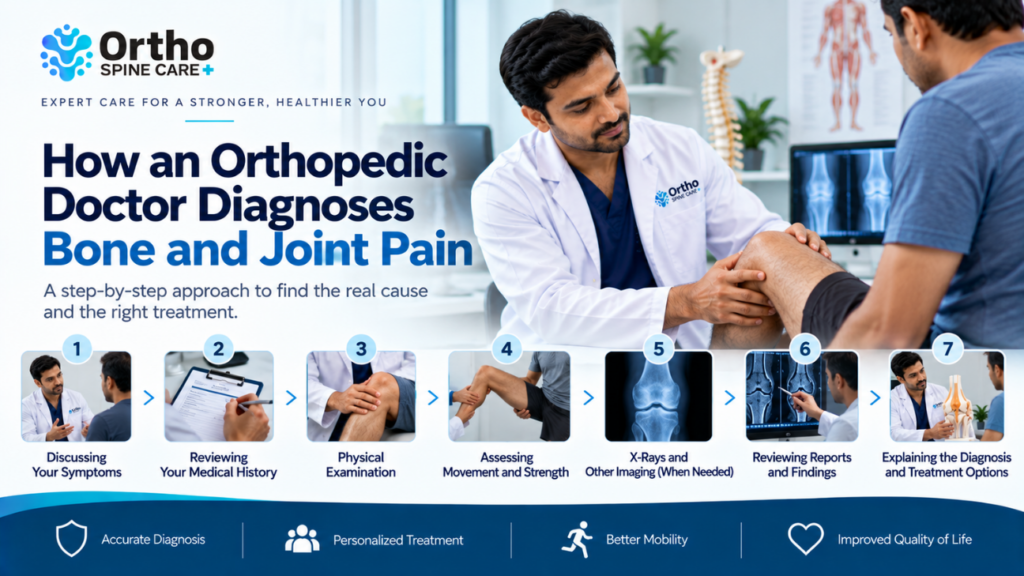
How an Orthopedic Doctor Diagnoses Bone and Joint Pain
Bone and joint pain can be frustrating, especially when you don’t know what’s causing it. A painful knee may be related to an injury, arthritis, overuse, or another joint problem. Similarly, back or shoulder pain can have several possible causes.
Because different conditions can produce similar symptoms, an orthopedic doctor usually looks beyond the location of the pain. The diagnosis involves understanding your symptoms, examining the affected area, and using tests or imaging when they are appropriate.
If you are looking for an orthopedic doctor in Bangalore, knowing what happens during the diagnostic process can help you feel more prepared for your consultation.
Why Is Proper Diagnosis Important?
Pain is a symptom rather than a diagnosis.
For example, two people may both have knee pain but have completely different underlying problems. One person may have an injury, while another may have arthritis or another joint condition.
Identifying the underlying cause helps an orthopedic doctor decide what type of treatment may be appropriate.
Treatment may involve:
- Medication
- Physiotherapy
- Rehabilitation
- Activity modification
- Pain management
- Injections
- Minimally invasive procedures
- Surgery when appropriate
Not every bone or joint problem requires surgery.
1. Your Doctor Will Ask About Your Pain
The diagnostic process usually starts with a conversation.
Your orthopedic doctor may ask questions such as:
- Where exactly does it hurt?
- When did the pain begin?
- Did it start suddenly or gradually?
- Did you have an injury?
- Is the pain constant or does it come and go?
- What activities make the pain worse?
- Does rest improve your symptoms?
- Do you have swelling or stiffness?
- Does the pain affect your sleep?
- Do you experience numbness or tingling?
- Has the problem affected your ability to walk or perform daily activities?
Try to describe your symptoms in your own words.
You don’t need to know the medical terminology. Explaining what you feel and when you experience it can give your doctor useful information.
2. Your Medical History Matters
Your previous health history can also help your doctor understand your current symptoms.
You may be asked about:
- Previous injuries
- Previous surgeries
- Existing medical conditions
- Medications
- Previous treatments
- Earlier X-rays or scans
- Previous episodes of similar pain
If you have already consulted another doctor or undergone imaging, take those reports with you if possible.
Previous medical information can help your orthopedic doctor understand what has already been investigated or treated.
3. A Physical Examination
After discussing your symptoms, your doctor may physically examine the affected area.
The examination depends on where you are experiencing pain.
For a knee problem, the doctor may assess:
- Range of motion
- Swelling
- Tenderness
- Stability
- Movement
For a shoulder problem, the examination may focus on:
- Shoulder movement
- Strength
- Tenderness
- Range of motion
For back or neck pain, the doctor may assess movement, strength, sensation, and other relevant findings.
The purpose of the examination is to understand how the affected area is functioning and identify signs that may help explain your symptoms.
4. Checking Your Movement and Range of Motion
Movement can provide important clues about certain bone and joint problems.
Your doctor may ask you to:
- Bend or straighten a joint
- Walk
- Raise your arm
- Rotate your shoulder
- Bend your back
- Perform another simple movement
The doctor may compare movement on one side with the other and observe whether particular movements cause pain or limitation.
This can help narrow down the possible causes of your symptoms.
5. Checking Strength and Stability
Depending on the condition, your orthopedic doctor may assess muscle strength and joint stability.
This can be particularly relevant for people with:
- Sports injuries
- Ligament problems
- Shoulder injuries
- Knee injuries
- Spine-related symptoms
Weakness or instability can provide additional information when combined with your symptoms and physical examination.
6. X-Rays and Other Imaging
Sometimes a physical examination and medical history are enough to begin treatment. In other situations, imaging may be useful.
An orthopedic doctor may recommend an X-ray or another appropriate investigation depending on your symptoms.
X-rays can provide information about bones and certain joint changes.
OrthoSpineCare lists digital X-rays and standing X-rays for spine and joint analysis among its diagnostic services.
For selected patients, bone-density assessment may also be appropriate. OrthoSpineCare lists bone-density/DEXA scan guidance as part of its diagnostic services.
The need for imaging depends on the individual’s symptoms and clinical assessment.
7. Looking at Previous Reports
If you have already undergone an X-ray, MRI, CT scan, or other investigation, your orthopedic doctor may review those reports as part of the consultation.
Previous reports can provide useful information about changes or injuries that have already been identified.
However, the doctor will consider imaging alongside your symptoms and physical examination rather than relying on a scan alone.
8. Diagnosing Spine-Related Pain
Back and neck pain can have several possible causes.
An orthopedic or spine specialist may evaluate symptoms associated with conditions such as:
- Sciatica
- Slipped discs
- Spondylosis
- Spinal injuries
- Scoliosis
- Spinal deformities
- Other spine-related problems
Symptoms such as pain travelling into an arm or leg, numbness, tingling, or weakness may provide additional information during the assessment.
OrthoSpineCare provides spine care for these and other spine-related conditions.
9. Diagnosing Sports Injuries
Sports injuries can affect muscles, tendons, ligaments, and joints.
If you have injured yourself while running, cycling, playing cricket, football, badminton, or working out at the gym, your doctor may assess:
- How the injury occurred
- Where the pain is located
- Swelling
- Movement
- Strength
- Stability
- Your ability to use the affected area
Depending on the injury, further investigation may be recommended.
OrthoSpineCare provides sports injury management for ligament and soft-tissue injuries, tendonitis, and rotator cuff injuries.
10. Understanding Joint Pain
Joint pain can have many causes.
An orthopedic doctor may consider factors such as:
- Your age
- Previous injuries
- Activity level
- Duration of symptoms
- Swelling or stiffness
- Range of motion
- Physical examination findings
- Relevant imaging
This can help distinguish between different possible causes and determine whether further evaluation or treatment is needed.
What Happens After the Diagnosis?
Once your doctor has assessed your symptoms, examination findings, and relevant investigations, they can explain the likely diagnosis and discuss treatment options.
Depending on the condition, treatment may include:
Non-surgical treatment
- Medication
- Physiotherapy
- Rehabilitation
- Activity modification
- Pain management
- Injections
Surgical treatment
Surgery may be considered for selected conditions when it is appropriate based on the diagnosis and individual circumstances.
The purpose of diagnosis is not simply to determine whether you need surgery. It is to understand the problem and identify an appropriate treatment approach.
When Should You See an Orthopedic Doctor?
Consider consulting an orthopedic specialist if you have:
- Persistent bone or joint pain
- Recurring knee pain
- Ongoing back or neck pain
- Difficulty moving a joint
- Persistent swelling or stiffness
- Pain after an injury
- A suspected fracture
- A sports injury that isn’t improving
- Pain travelling into an arm or leg
- Numbness or tingling associated with musculoskeletal symptoms
- Pain that affects your sleep or everyday activities
You don’t necessarily have to wait until the pain becomes severe.
An evaluation can help you understand what may be causing your symptoms and whether treatment is appropriate.
How Can You Prepare for Your Appointment?
A little preparation can make your consultation more useful.
Before your appointment, note:
- When your symptoms started
- Where you feel the pain
- What makes it worse
- What makes it better
- Any previous injuries
- Previous surgeries
- Current medications
- Previous treatments
- Relevant medical reports
- How the problem affects your daily life
You can also prepare questions such as:
What could be causing my pain?
Do I need any tests or imaging?
What treatment options are available?
Can this condition be managed without surgery?
Will I need physiotherapy?
What should I avoid during recovery?
When should I return for a follow-up?
Choosing an Orthopedic Doctor in Bangalore
If you are searching for an orthopedic doctor in Bangalore, consider the doctor’s qualifications, area of specialization, experience with your condition, available diagnostic services, and treatment options.
For patients in North Bangalore, OrthoSpineCare in Sadashivanagar provides orthopaedic and spine care under Dr. Prajwal GS.
Dr. Prajwal GS’s listed qualifications include MBBS, MS Orthopaedics, fellowship training in spine surgery, minimally invasive spine surgery and orthopaedic rheumatology, along with an AO Global Spine Diploma.
The clinic provides care for spine conditions, fractures, bone and joint problems, sports injuries, pain management, rehabilitation, diagnostic services, and surgical conditions.
Finding the Cause Is the First Step
Bone and joint pain can have many possible causes, and the location of the pain alone may not tell you what is wrong.
A proper orthopedic assessment brings together your symptoms, medical history, physical examination, and appropriate investigations to build a clearer picture of the problem.
Once the cause is better understood, your doctor can discuss the treatment options that may be suitable for you.
If persistent pain or reduced mobility is affecting your everyday life, consider consulting a qualified orthopedic doctor in Bangalore for an individual evaluation.
OrthoSpineCare
No. 2, 10th Cross Road, Sadashivanagar, Bangalore – 560080
Phone: 9740559577
This article is intended for general educational purposes and does not replace an individual medical consultation. Treatment recommendations depend on the patient’s condition and clinical assessment.