
Spine Surgery vs Non-Surgical Treatment: What Is Right for You?
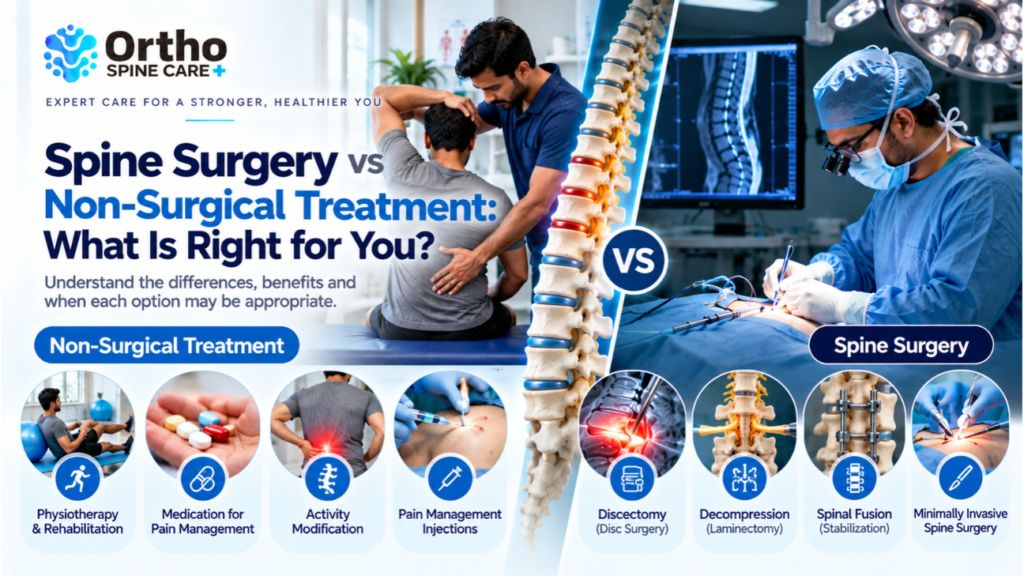
Back pain can affect more than just your physical comfort. It may make it difficult to sit at work, drive, walk, exercise, or even enjoy a good night’s sleep. When the discomfort continues despite trying medication or other treatments, you may start wondering whether spine surgery is the next step.
However, surgery is not always necessary for spinal conditions. Many people can manage their symptoms through non-surgical treatments, while others may benefit from a surgical procedure depending on the underlying problem.
So, how do you know which option is right for you?
The answer depends on your diagnosis, the severity of your symptoms, nerve involvement, overall health, and response to previous treatment.
If you are looking for a spine surgeon in Bangalore, this guide will help you understand the differences between surgical and non-surgical spine treatments and what to consider before making a decision.
Understanding Spine Problems
The spine is an important part of your body’s structure. It supports your weight, allows movement, and protects the spinal cord and associated nerves.
However, different conditions can affect the spine and cause pain, stiffness, numbness, or restricted movement.
Some common spine-related conditions include:
- Slipped or herniated discs
- Sciatica
- Cervical spondylosis
- Lumbar spondylosis
- Spinal stenosis
- Spinal injuries
- Scoliosis and spinal deformities
- Nerve compression
- Certain degenerative spine conditions
Although these conditions can produce similar symptoms, their treatment requirements may be different. Therefore, an accurate diagnosis is the first step before deciding whether surgery or conservative treatment is appropriate.
1. What Is Non-Surgical Spine Treatment?
Non-surgical spine treatment refers to approaches used to manage spinal conditions without performing an operation.
Depending on the diagnosis, these treatments may help reduce pain, improve movement, strengthen supporting muscles, and support everyday activities.
For many patients, conservative treatment is considered before surgery, provided there are no urgent indications for an operation.
Common non-surgical treatments include:
Physiotherapy and Rehabilitation
Physiotherapy is an important part of managing several spine-related conditions.
A physiotherapist may recommend exercises designed to improve flexibility, strengthen supporting muscles, and restore comfortable movement.
Depending on your condition, the programme may include:
- Back and abdominal strengthening exercises
- Stretching exercises
- Posture and movement guidance
- Flexibility training
- Core stability exercises
- Gradual activity restoration
For example, someone experiencing certain types of lower back pain may benefit from a structured exercise programme that improves muscle strength and movement.
However, exercises should be selected according to the underlying condition. Not every exercise is suitable for every spinal problem.
Medication for Pain Management
Your doctor may recommend appropriate medication to help manage pain or inflammation.
Depending on your symptoms and medical history, this may include pain-relieving or anti-inflammatory medicines.
Medication can sometimes make everyday activities and rehabilitation more manageable. However, it does not necessarily correct the underlying structural problem.
Therefore, it is important to follow medical advice and avoid taking pain medication regularly without professional guidance.
Activity Modification
Certain movements or activities may aggravate existing spine problems.
For instance, prolonged sitting, repetitive bending, heavy lifting, or particular workout movements may increase discomfort in some patients.
Your doctor may recommend temporarily modifying these activities while maintaining appropriate movement.
The goal is to reduce unnecessary stress on the affected area without becoming completely inactive.
Pain Management Injections
For selected spinal conditions, doctors may consider injections to help manage pain and inflammation.
Depending on the diagnosis, options may include certain epidural or other targeted injections.
These treatments may provide symptom relief in appropriate patients, although the duration and degree of improvement can vary.
Injections are not suitable for everyone, and they do not necessarily repair damaged discs or reverse structural changes.
Your specialist can explain whether an injection is appropriate and discuss its potential benefits and risks.
2. What Is Spine Surgery?
Spine surgery involves procedures performed to address specific structural problems affecting the spine, spinal nerves, or surrounding structures.
It may be recommended when a condition causes significant symptoms, nerve compression, instability, or other problems that are unlikely to improve sufficiently with non-surgical treatment.
Depending on the diagnosis, spine surgery may aim to:
- Relieve pressure on compressed nerves
- Remove or address problematic disc material
- Improve spinal stability
- Correct certain spinal deformities
- Treat selected spinal injuries
- Address specific structural abnormalities
The exact procedure depends on the patient’s condition and clinical findings.
Common Types of Spine Surgery
Discectomy: A procedure that removes part of a problematic spinal disc when it is compressing a nerve and causing appropriate symptoms.
Laminectomy: A procedure that removes part of the vertebral bone to create more space for compressed nerves in selected cases.
Spinal Fusion: A procedure that joins two or more vertebrae to provide stability when clinically indicated.
Minimally Invasive Spine Surgery: Certain spine procedures can be performed using specialized instruments and smaller incisions, depending on the condition and surgical requirements.
Not every patient needs these procedures. Your surgeon should explain which procedure, if any, is suitable for your diagnosis.
3. Spine Surgery vs Non-Surgical Treatment: What Is the Difference?
Both approaches have different purposes, benefits, and limitations.
| Factor | Non-Surgical Treatment | Spine Surgery |
|---|---|---|
| Approach | Manages symptoms and function without an operation | Addresses selected structural or nerve-related problems |
| Treatment | Medication, physiotherapy, injections and rehabilitation | Procedures such as discectomy, decompression or fusion |
| Recovery | Depends on the condition and treatment | Depends on the procedure and individual recovery |
| Hospital stay | Often managed on an outpatient basis | May require hospital admission |
| Risks | Medication side effects and treatment-related limitations | Surgical and anaesthesia-related risks |
| Suitability | Many conditions with appropriate clinical indications | Selected conditions where surgery offers meaningful benefit |
Neither approach is automatically better than the other.
The right choice depends on what is causing your symptoms and which treatment offers the most appropriate balance of benefits and risks.
4. When Is Non-Surgical Treatment the Better Option?
Non-surgical treatment may be appropriate when symptoms are manageable and there are no urgent neurological or structural concerns.
For example, certain cases of lower back pain, uncomplicated disc-related symptoms, and some degenerative spine conditions may initially be managed conservatively.
Your doctor may recommend non-surgical treatment if:
- Pain is manageable with appropriate care.
- There is no significant or progressive neurological weakness.
- The condition does not require urgent surgical intervention.
- Symptoms may improve with rehabilitation.
- You have not yet tried appropriate conservative treatment.
However, treatment should be monitored. If symptoms worsen or new neurological problems develop, your doctor may need to reassess the approach.
5. When Might Spine Surgery Be Necessary?
Although many spinal conditions can be managed without surgery, certain situations may require an operation.
A spine surgeon may consider surgery when:
Persistent Symptoms Despite Appropriate Treatment
If pain continues to significantly affect your everyday life despite an adequate course of appropriate non-surgical treatment, surgery may be discussed for selected conditions.
Significant Nerve Compression
A herniated disc or spinal stenosis may compress nearby nerves and cause pain, numbness, or weakness.
If the compression produces significant symptoms or neurological problems, surgical treatment may be considered.
Progressive Muscle Weakness
Increasing weakness in an arm or leg can indicate worsening nerve involvement.
This requires prompt medical assessment, and depending on the cause, timely surgery may be necessary.
Spinal Instability
Certain spinal conditions or injuries can affect the stability of the vertebrae.
In selected cases, surgery may be recommended to restore stability and address the underlying problem.
Certain Spinal Injuries
Some spinal fractures and traumatic injuries require surgical treatment depending on their location, severity, and stability.
Importantly, new bladder or bowel dysfunction, numbness around the groin or saddle area, or rapidly worsening weakness alongside back pain can indicate an emergency. Seek immediate medical attention rather than waiting for a routine consultation.
6. What About Minimally Invasive Spine Surgery?
Advances in medical technology have introduced minimally invasive techniques for selected spinal procedures.
Unlike some conventional operations, these procedures use specialized instruments and smaller incisions to access the affected spinal structures.
Depending on the procedure and patient, potential advantages may include:
- Less disruption to surrounding tissues
- Smaller surgical incisions
- Reduced blood loss in some procedures
- Shorter hospital stays in selected cases
- Potentially faster initial recovery
However, minimally invasive surgery is not appropriate for every spinal condition.
For example, some complex deformities or extensive spinal problems may require a different surgical approach.
Therefore, the decision should be based on your diagnosis, anatomy, expected outcome, and the surgeon’s assessment rather than the size of the incision alone.
7. Can You Avoid Spine Surgery With Physiotherapy?
In some cases, yes.
Physiotherapy can play an important role in managing selected spine conditions, particularly when the main treatment goals involve improving strength, flexibility, movement, and physical function.
For example, people with certain types of lower back pain may benefit from exercises that strengthen their core and supporting muscles.
Similarly, appropriate rehabilitation may help patients return to normal activities after some injuries.
However, physiotherapy cannot resolve every structural spinal problem.
If a patient has significant nerve compression, progressive weakness, spinal instability, or another condition requiring surgical attention, exercises alone may not be sufficient.
Consequently, physiotherapy should be part of a treatment plan based on an appropriate diagnosis.
8. What Are the Risks of Spine Surgery?
Like any major medical procedure, spine surgery carries potential risks.
These may vary depending on the type of operation, the patient’s health, and the complexity of the condition.
Possible complications include:
- Infection
- Bleeding
- Blood clots
- Anaesthesia-related complications
- Nerve injury
- Persistent pain
- Failure to achieve the expected improvement
- Complications related to spinal implants or fusion, where applicable
Your surgeon should explain the risks relevant to your particular procedure and medical circumstances.
In addition, ask about expected recovery, activity restrictions, rehabilitation, and the possibility of needing further treatment.
Understanding these factors before surgery can help you make a more informed decision.
9. How Do You Decide Which Treatment Is Right for You?
Choosing between surgery and non-surgical treatment should never be based on fear, assumptions, or someone else’s experience.
Two people with similar MRI findings may require different treatments because their symptoms, examination findings, and medical circumstances may differ.
Your spine specialist may consider:
1. Your symptoms: How severe is the pain, and how does it affect your daily life?
2. Your diagnosis: What is the underlying condition causing the symptoms?
3. Neurological findings: Is there numbness, weakness, or evidence of nerve compression?
4. Imaging results: Do X-rays, MRI scans, or other investigations support the clinical findings?
5. Previous treatment: Have appropriate non-surgical options been tried, and how did you respond?
6. Overall health: Do other medical conditions influence the available treatment options?
7. Your recovery goals: What activities do you want to return to, and what improvement is realistic?
After considering these factors, your doctor can discuss the available approaches and recommend a treatment plan suited to your condition.
10. Questions to Ask Your Spine Surgeon Before Making a Decision
If surgery has been recommended, it is completely reasonable to ask for more information before proceeding.
Consider asking:
- What exactly is causing my symptoms?
- Why are you recommending surgery?
- Can my condition be treated without surgery?
- What are the benefits and risks of the proposed procedure?
- Is minimally invasive surgery suitable for me?
- What could happen if I delay the operation?
- How long might recovery take?
- Will I need physiotherapy after surgery?
- When can I return to work and normal activities?
These questions can help you understand the reasoning behind the treatment recommendation.
If you remain uncertain about major surgery, seeking a second opinion from another qualified spine specialist may also be helpful, provided doing so does not delay urgent care.
Choosing a Spine Surgeon in Bangalore
If you are looking for a spine surgeon in Bangalore, consider the doctor’s qualifications, specialist training, experience with your particular condition, and ability to explain both surgical and non-surgical treatment options.
For patients in North Bangalore, OrthoSpineCare in Sadashivanagar provides orthopaedic and spine care under Dr. Prajwal GS.
Dr. Prajwal GS’s listed qualifications include:
- MBBS – Kempegowda Institute of Medical Sciences, Bangalore
- MS Orthopaedics – J.J.M. Medical College, Davanagere
- Fellowship in Spine Surgery – Mallika Spine Centre, Guntur
- Fellowship in Minimally Invasive Spine Surgery – Mumbai
- Fellowship in Orthopaedic Rheumatology
- AO Global Spine Diploma – AO Spine, Davos, Switzerland
The clinic’s listed services include spine care, minimally invasive spine procedures, bone and joint treatment, fracture and trauma management, sports injury care, pain management, and rehabilitation guidance.
Patients can discuss their symptoms, previous investigations, and available treatment approaches during an individual consultation.
Book a Consultation
OrthoSpineCare
No. 2, 10th Cross Road, Sadashivanagar, Bangalore – 560080
Phone: 9740559577
Final Thoughts
Choosing between spine surgery and non-surgical treatment is an important decision, but it does not have to be confusing.
While many spinal conditions can improve with appropriate conservative care, others may require surgery to address nerve compression, instability, or significant structural problems.
The most important step is to understand your diagnosis before deciding on treatment. A qualified spine specialist can evaluate your symptoms, review relevant investigations, explain the available options, and help you understand the potential benefits and risks of each approach.
If persistent back pain, neck pain, sciatica, or other spine-related symptoms are affecting your everyday life, consider consulting a qualified specialist to discuss the treatment options appropriate for you.
This article is intended for general educational purposes and does not replace an individual medical consultation. Treatment recommendations depend on the patient’s diagnosis, symptoms, examination findings, medical history, investigations, and clinical circumstances.