
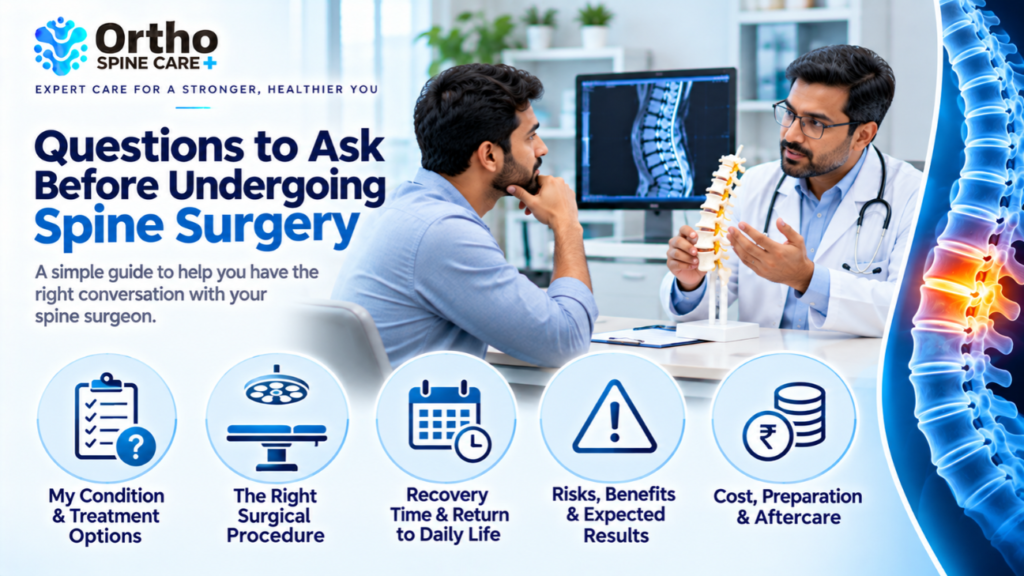
Questions to Ask Before Undergoing Spine Surgery
Being told that you may need spine surgery can bring a lot of questions and uncertainty. You might be worried about the procedure, possible complications, recovery time, or whether you will be able to return to your normal activities.
Whether you are dealing with a slipped disc, spinal stenosis, nerve compression, or another spinal condition, deciding to undergo surgery is an important healthcare decision. Although modern surgical techniques have improved treatment options, understanding the procedure and its expected outcomes is essential before moving forward.
One of the best ways to prepare is by having an open conversation with your spine surgeon.
However, many patients are unsure about what to ask during their consultation. They may leave the appointment with unanswered questions simply because they did not know what information to discuss.
If you are considering spine surgery in Bangalore, this guide covers the important questions you should ask your surgeon before making a decision.
1. What Exactly Is My Spine Condition?
Before discussing surgery, make sure you understand the condition affecting your spine.
Your doctor may have diagnosed a slipped disc, herniated disc, spinal stenosis, spondylosis, or another spinal problem. However, simply knowing the medical name is not enough.
Ask your surgeon to explain:
- What exactly is happening in my spine?
- Which part of my spine is affected?
- Are my nerves being compressed?
- What is causing my pain or other symptoms?
- How serious is my condition?
- Will the condition become worse over time?
Understanding your diagnosis helps you make sense of the recommended treatment.
For example, two patients may have similar MRI findings but require different treatment approaches because their symptoms and examination results are different.
Therefore, ask your doctor to explain how your scan findings relate to your actual symptoms.
2. Why Do I Need Spine Surgery?
This is one of the most important questions to ask before agreeing to an operation.
Not every spinal condition requires surgery. Many patients improve with appropriate medication, physiotherapy, rehabilitation, and other non-surgical treatments.
However, surgery may be recommended when there is significant nerve compression, spinal instability, certain spinal injuries, or persistent symptoms that have not improved with appropriate conservative treatment.
Ask your surgeon:
- Why are you recommending surgery in my case?
- What problem will the operation address?
- Is the surgery necessary immediately?
- What are the expected benefits?
- What could happen if I delay the procedure?
Understanding the medical reason behind the recommendation can help you make a more confident and informed decision.
If your condition requires urgent intervention, make sure you understand why delaying treatment could be harmful.
3. Are There Any Non-Surgical Treatment Options?
Before proceeding with surgery, it is reasonable to understand whether other treatment options are available.
Depending on your diagnosis, non-surgical approaches may include:
- Physiotherapy
- Medication for pain management
- Activity modification
- Posture and movement guidance
- Rehabilitation exercises
- Selected pain management injections
For example, certain cases of sciatica or a herniated disc may improve without surgery.
However, conservative treatment is not appropriate for every situation. Some conditions require timely surgical attention, particularly when neurological function is at risk.
Ask your surgeon:
- Can my condition be managed without surgery?
- Have I tried the appropriate non-surgical treatments?
- How likely is conservative treatment to help?
- What are the risks of delaying surgery?
- What symptoms would indicate that surgery is necessary?
These questions help you understand whether an operation is the most suitable option for your circumstances.
4. What Type of Spine Surgery Will Be Performed?
There are different types of spine surgery, and the procedure recommended depends on the underlying condition.
Your surgeon may discuss procedures such as:
Discectomy: Removes problematic disc material that is compressing a nearby nerve.
Laminectomy: Removes part of the vertebral bone to create additional space for compressed nerves.
Spinal Fusion: Joins two or more vertebrae to provide stability when necessary.
Endoscopic Spine Surgery: Uses a small camera and specialized instruments to treat selected spinal conditions through a relatively small incision.
Minimally Invasive Spine Surgery: Uses specialized instruments and smaller access incisions for selected spinal procedures.
Before proceeding, ask:
- Which procedure is suitable for my condition?
- Why is this particular technique recommended?
- Are there alternative surgical approaches?
- Will implants or screws be required?
- How many spinal levels will be treated?
Understanding the procedure beforehand can reduce uncertainty and help you prepare for surgery.
5. Am I Suitable for Minimally Invasive Spine Surgery?
Advances in surgical techniques have made minimally invasive procedures an option for selected spinal conditions.
These techniques are designed to access the affected spinal structures through smaller incisions while limiting unnecessary disruption to surrounding muscles and tissues.
However, minimally invasive surgery is not suitable for every patient.
Ask your surgeon:
- Am I eligible for minimally invasive surgery?
- Would endoscopic surgery be an option?
- What are the advantages compared with open surgery?
- Are there any limitations?
- Would another surgical approach provide a better result?
The most important consideration is selecting a procedure that safely addresses your spinal condition rather than choosing one simply because it involves a smaller incision.
6. What Are the Possible Risks and Complications?
Every surgical procedure carries some degree of risk. Spine surgery is no exception.
Although many patients undergo spine procedures successfully, complications can sometimes occur.
Depending on the operation, potential risks may include:
- Infection
- Bleeding
- Blood clots
- Nerve injury
- Dural tear or spinal fluid leakage
- Persistent or recurring pain
- Complications related to spinal implants
- Anaesthesia-related complications
- Need for additional surgery
The risks vary depending on your health, the complexity of the operation, and the type of procedure.
Make sure you ask:
- What are the most common risks of this surgery?
- Are there any risks specific to my condition?
- What complications should I watch for?
- How are complications managed?
- Does my medical history increase any particular risks?
Your surgeon should explain the risks in a way that you can understand before providing consent.
7. How Successful Is This Surgery?
Patients naturally want to know whether surgery will solve their problem.
However, the expected outcome depends on the condition being treated, the severity of symptoms, the duration of nerve compression, and several individual factors.
Instead of asking only whether the surgery will be successful, ask more specific questions:
- What improvement can I realistically expect?
- Is the main goal pain relief, improved movement, or nerve decompression?
- Will my numbness or weakness improve?
- How likely are my symptoms to return?
- Are there any symptoms that may remain after surgery?
For example, some patients experience improvement in nerve-related pain relatively quickly, while numbness or muscle weakness may take longer to recover.
In certain cases, longstanding nerve damage may not completely resolve.
Understanding realistic expectations is important because surgery does not guarantee complete freedom from pain.
8. How Long Will the Surgery Take?
The duration of spine surgery depends on the procedure, the number of spinal levels involved, and the complexity of the condition.
A relatively straightforward procedure may take less time than a complex spinal reconstruction or multilevel fusion.
Ask your surgeon:
- How long will the operation take?
- Will I need general anaesthesia?
- How long will I remain in the recovery room?
- Will I need to stay overnight in the hospital?
- When can I start walking after surgery?
Knowing the expected schedule can help you and your family plan for the hospital visit and recovery period.
9. How Long Will Recovery Take?
Recovery is one of the biggest concerns for patients considering spine surgery.
Some people may resume light activities within days or weeks after certain minimally invasive procedures. However, more complex procedures, particularly spinal fusion, may require several months of recovery.
Your recovery timeline depends on the operation, your overall health, and your body’s healing response.
Ask your surgeon:
- How long will initial recovery take?
- When can I walk independently?
- When can I return to work?
- When can I drive?
- When can I resume exercise?
- Will I need physiotherapy?
- How long before I can return to my normal routine?
For example, a person working at a desk may return to work earlier than someone whose job involves lifting heavy objects.
Your surgeon should provide a recovery plan based on your specific procedure and medical condition.
10. Will I Need Physiotherapy After Surgery?
Surgery may address the structural problem, but rehabilitation can play an important role in restoring strength and movement.
Depending on the procedure, your doctor may recommend physiotherapy to help you:
- Improve flexibility
- Strengthen supporting muscles
- Restore comfortable movement
- Improve balance and coordination
- Increase walking ability
- Return to everyday activities
However, physiotherapy does not always begin immediately after surgery.
The timing and type of exercises depend on the procedure and the healing process.
Ask your surgeon:
- When should I begin physiotherapy?
- How many sessions might I need?
- Which exercises should I avoid?
- Will I need a supervised rehabilitation programme?
- How will my recovery progress be monitored?
Following an appropriate rehabilitation programme can help support functional recovery.
11. What Activities Should I Avoid After Surgery?
Returning to normal activities too early may interfere with recovery.
Depending on the procedure, your surgeon may temporarily restrict certain movements and activities.
These may include:
- Heavy lifting
- Repeated bending
- Sudden twisting movements
- High-impact exercises
- Heavy weight training
- Certain sports activities
- Prolonged sitting without movement breaks
However, restrictions differ between procedures.
Ask your doctor for clear instructions about daily activities, sleeping positions, walking, lifting, driving, and exercise.
Also, understand when you can gradually resume these activities safely.
12. What Preparations Are Required Before Surgery?
Preparing for surgery involves more than arranging a hospital appointment.
Your medical team may recommend certain investigations and health assessments before the procedure.
Depending on your condition, preparations may include:
- Blood investigations
- MRI scans or X-rays
- CT scans when necessary
- Cardiac or other medical assessments when indicated
- Anaesthesia evaluation
- Review of existing medications
- Instructions regarding fasting
Make sure your surgeon knows about your existing medical conditions, allergies, previous surgeries, and all medications or supplements you take.
Ask whether any medicines need to be adjusted before surgery. Never stop prescribed medication without medical advice.
You should also arrange transportation and assistance at home for the initial recovery period.
13. What Will the Surgery Cost?
Understanding the financial aspects of treatment is another important part of planning.
Spine surgery costs can vary depending on the procedure, hospital facilities, medical requirements, and duration of hospitalization.
Before proceeding, ask for an estimate covering:
- Surgeon and consultation charges
- Operation theatre expenses
- Anaesthesia charges
- Hospital room charges
- Medical investigations
- Implants or surgical equipment, if required
- Medicines
- Postoperative follow-up
- Physiotherapy and rehabilitation
If you have health insurance, check what is covered and whether any exclusions, waiting periods, or approval requirements apply.
A clear cost estimate can help prevent unexpected financial difficulties during treatment.
14. What Happens If the Surgery Does Not Provide Enough Relief?
Although many patients experience improvement after appropriate spine surgery, outcomes cannot be guaranteed.
Some people may continue to experience pain, numbness, or other symptoms even after the operation.
Ask your surgeon:
- What happens if my symptoms do not improve?
- Could I require additional treatment?
- Will I need further investigations?
- What are the options if pain continues?
- How will my condition be monitored after surgery?
Understanding the possibilities beforehand helps you prepare for different outcomes.
It is also important to understand that some symptoms, particularly those related to longstanding nerve damage, may take longer to improve or may not completely resolve.
15. Should I Consider a Second Opinion?
If you have been advised to undergo major spine surgery and are uncertain about the recommendation, seeking a second opinion from another qualified spine specialist may be helpful.
A second opinion can provide additional perspective on your diagnosis, imaging findings, treatment options, and the reasons for recommending surgery.
It may also help you understand whether conservative treatment or another surgical approach is appropriate.
However, do not delay urgent medical treatment when your doctor identifies a time-sensitive condition.
A Quick Checklist: Questions to Ask Before Spine Surgery
Before your consultation, consider saving this checklist so you do not forget important questions.
- What exactly is my spinal condition?
- Why do I need surgery?
- Are non-surgical treatments available?
- Which surgical procedure is recommended?
- Am I suitable for minimally invasive surgery?
- What are the possible risks and complications?
- What results can I realistically expect?
- How long will the procedure take?
- How long will recovery take?
- Will I need physiotherapy?
- When can I return to work and exercise?
- What will the total treatment cost be?
- What happens if symptoms continue after surgery?
You do not need to ask every question in a single conversation. However, understanding these important areas can help you make a well-informed decision.
When Should You Consult a Spine Surgeon?
If persistent back or neck pain is affecting your everyday activities, consulting an appropriate specialist can help identify the underlying cause.
Consider a specialist evaluation if you experience:
- Persistent lower back or neck pain
- Pain travelling into your arms or legs
- Recurring sciatica
- Numbness or tingling
- Muscle weakness
- Difficulty walking
- A diagnosed slipped disc with persistent symptoms
- Spinal problems that have not improved with appropriate treatment
Certain symptoms require emergency medical attention. New loss of bladder or bowel control, numbness around the groin or saddle area, or rapidly worsening weakness alongside back pain may indicate serious nerve compression. Seek emergency medical evaluation rather than waiting for a routine appointment.
Spine Consultation at OrthoSpineCare, Bangalore
Choosing the right specialist is an important step when considering spine surgery.
If you are searching for a spine surgeon in Bangalore, consider the doctor’s qualifications, specialist training, experience, and approach to both surgical and non-surgical treatments.
OrthoSpineCare, located in Sadashivanagar, Bangalore, provides orthopaedic and spine care under Dr. Prajwal GS.
According to the clinic’s listed profile, Dr. Prajwal GS holds the following qualifications:
- MBBS – Kempegowda Institute of Medical Sciences, Bangalore
- MS Orthopaedics – J.J.M. Medical College, Davanagere
- Fellowship in Spine Surgery – Mallika Spine Centre, Guntur
- Fellowship in Minimally Invasive Spine Surgery – Mumbai
- Fellowship in Orthopaedic Rheumatology
- AO Global Spine Diploma – AO Spine, Davos, Switzerland
The clinic’s listed services include spine care, minimally invasive spine procedures, fracture and trauma management, bone and joint treatment, sports injury management, pain management, and rehabilitation guidance.
If you have been advised to undergo spine surgery, an individual consultation can help you understand your diagnosis, treatment options, potential risks, and expected recovery.
Book a Consultation
OrthoSpineCare
No. 2, 10th Cross Road, Sadashivanagar, Bangalore – 560080 (Near Rashtrotthana Yoga Centre)
Phone: 9740559577
Website: https://orthospinecare.in/
Final Thoughts
Spine surgery is an important medical decision, and it is completely normal to have questions before proceeding.
Rather than focusing only on the procedure itself, take time to understand your diagnosis, why surgery is being recommended, what alternatives are available, and what recovery may involve.
A good consultation should give you the opportunity to discuss your concerns, understand potential risks, and make a decision based on your individual medical needs.
Remember, the goal of spine treatment is not simply to perform an operation. It is to address the underlying problem, protect neurological function where possible, reduce symptoms, and help you regain a better quality of life.
If you have been advised to undergo spine surgery, prepare your questions and discuss them openly with a qualified spine specialist before making your decision.
Medical Disclaimer: This article is intended for general educational purposes and does not replace professional medical advice, diagnosis, or treatment. Every patient’s condition is different, and treatment recommendations should be based on an individual medical evaluation.