
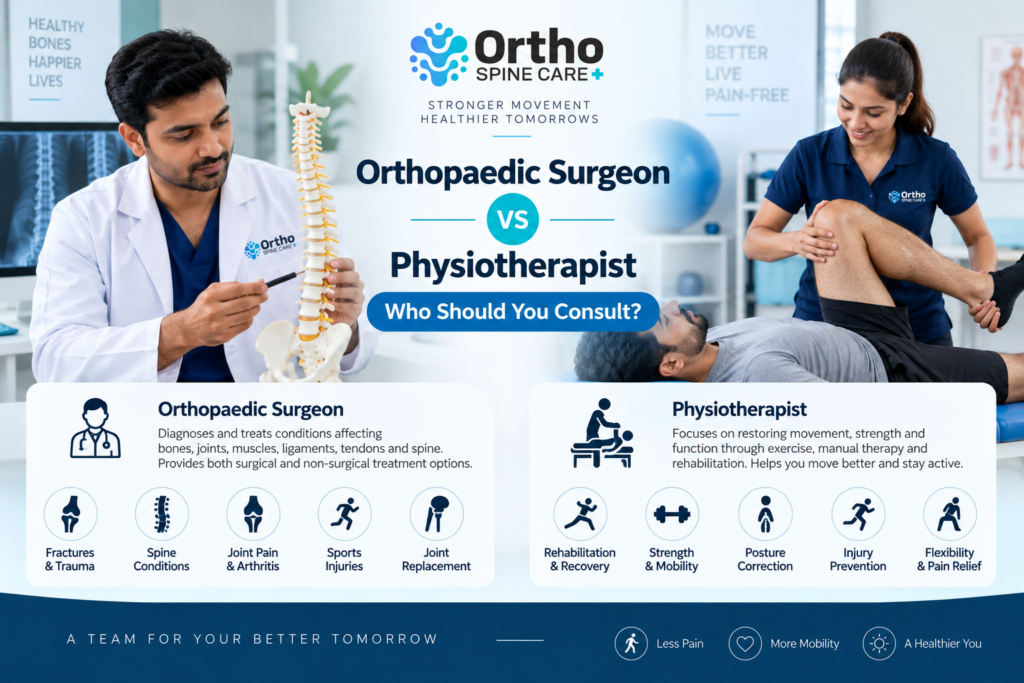
Orthopaedic Surgeon vs Physiotherapist: Who Should You Consult?
When you have back pain, knee discomfort, a sports injury, or difficulty moving a joint, one question often comes to mind: Should I see an orthopaedic surgeon or a physiotherapist?
Both professionals play an important role in musculoskeletal healthcare, but their roles are different. An orthopaedic surgeon focuses on diagnosing and treating conditions affecting the bones, joints, muscles, ligaments, tendons, and spine. A physiotherapist focuses mainly on improving movement, strength, flexibility, and physical function through rehabilitation and therapeutic exercises.
In many situations, you may even benefit from both. The right choice depends on what is causing your symptoms and how severe or persistent they are.
If you are searching for an orthopaedic surgeon in Bangalore, understanding the difference between these two professionals can help you make a more informed decision.
What Does an Orthopaedic Surgeon Do?
An orthopaedic surgeon is a medical doctor who specializes in conditions affecting the musculoskeletal system.
This includes problems involving:
- Bones
- Joints
- Spine
- Muscles
- Ligaments
- Tendons
An orthopaedic surgeon can evaluate an injury or persistent pain, make a diagnosis, recommend investigations when appropriate, and discuss both surgical and non-surgical treatment options.
Importantly, seeing an orthopaedic surgeon does not automatically mean you will need surgery.
Many orthopaedic conditions can initially be managed with conservative treatment, such as medication, activity modification, physiotherapy, rehabilitation, pain management, or injections. Surgery may be considered when it is appropriate for the specific condition.
What Does a Physiotherapist Do?
Physiotherapists specialize in helping people restore movement and physical function.
They commonly work with patients recovering from injuries, surgery, chronic pain, or conditions that affect mobility.
Physiotherapy may involve:
- Therapeutic exercises
- Strengthening programs
- Stretching
- Mobility exercises
- Movement training
- Posture guidance
- Rehabilitation
- Functional recovery
For example, after an orthopaedic injury or surgery, physiotherapy may be an important part of the recovery process.
The goal is usually to help you move better, become stronger, return to normal activities, and reduce the risk of future problems.
Orthopaedic Surgeon vs Physiotherapist: What’s the Difference?
The simplest way to understand the difference is this:
An orthopaedic surgeon diagnoses and manages musculoskeletal conditions, including conditions that may require surgery. A physiotherapist focuses on restoring movement, strength, and function through rehabilitation.
However, there is considerable overlap in patient care.
For example, someone with knee pain may first need an orthopaedic assessment to determine whether the problem is related to arthritis, an injury, a ligament problem, or another condition. Once the diagnosis is established, physiotherapy may become an important part of treatment.
In other cases, someone with mild muscle stiffness or a movement problem may benefit from physiotherapy without needing surgical evaluation.
When Should You See an Orthopaedic Surgeon?
Consider consulting an orthopaedic specialist when you have a problem that may require medical diagnosis or specialist assessment.
Examples include:
1. Persistent Joint Pain
If knee, shoulder, hip, ankle, wrist, or other joint pain continues for several weeks or keeps returning, an orthopaedic evaluation may help identify the underlying cause.
2. Significant Injury
Falls, road accidents, sports injuries, and other trauma can result in fractures, dislocations, ligament injuries, or other structural problems.
An orthopaedic assessment can help determine the extent of the injury and the appropriate treatment.
3. Severe or Recurring Back Pain
Persistent back or neck pain may have several possible causes.
Conditions such as sciatica, slipped discs, spondylosis, spinal injuries, scoliosis, and other spine problems may require assessment by a spine or orthopaedic specialist.
4. Pain That Travels Into Your Arm or Leg
Pain that travels from your back into your leg or from your neck into your arm can sometimes be associated with nerve irritation.
If these symptoms persist or are accompanied by numbness, tingling, or weakness, specialist assessment is advisable.
5. Difficulty Moving a Joint
If you suddenly lose movement or gradually find it harder to use a joint, it is worth finding out why.
An orthopaedic specialist can evaluate the problem and determine whether further investigations or treatment are required.
6. You May Need Surgery
Certain fractures, severe joint damage, ligament injuries, spinal conditions, and other problems may eventually require surgery.
An orthopaedic surgeon can determine whether surgery is appropriate and explain the available options.
When Should You See a Physiotherapist?
Physiotherapy can be particularly useful when your main goal is to improve movement, strength, flexibility, and physical function.
You may benefit from physiotherapy when:
- You are recovering from an injury
- You have muscle weakness or stiffness
- You are recovering after surgery
- You have difficulty with movement
- You need help returning to physical activity
- You have been advised to follow a rehabilitation program
- Poor posture or movement patterns are contributing to discomfort
- You need a structured exercise-based recovery plan
Physiotherapy can also play an important role in preventing future injuries by helping improve strength, flexibility, balance, and movement patterns.
What About Back Pain?
Back pain is a good example of why choosing between an orthopaedic surgeon and physiotherapist is not always straightforward.
If you have mild back discomfort after sitting for a long time, a physiotherapy-based approach may be useful.
However, persistent, severe, recurring, or radiating back pain may require an assessment by an orthopaedic or spine specialist first.
For example, symptoms associated with a slipped disc or sciatica may need a proper diagnosis before beginning a rehabilitation program.
Once the underlying problem has been evaluated, physiotherapy may become an important part of the treatment plan.
What About Knee Pain?
Knee pain can also have many different causes.
It could be related to:
- Arthritis
- Sports injuries
- Ligament problems
- Tendon problems
- Overuse
- Joint degeneration
- Previous injuries
A physiotherapist can help with strength, mobility, movement, and rehabilitation. However, if the pain is persistent, severe, associated with an injury, or affecting your ability to walk and perform everyday activities, an orthopaedic evaluation may be appropriate.
The important thing is to understand the cause before deciding on treatment.
Can You Need Both?
Absolutely.
In fact, many patients benefit from coordinated care.
Imagine someone who has undergone an orthopaedic procedure. The surgeon may address the underlying structural problem, while the physiotherapist helps the patient regain strength, flexibility, balance, and movement during recovery.
Similarly, a patient with a sports injury may require medical assessment first and then follow a rehabilitation program to safely return to their sport.
This teamwork can make the recovery process more structured and personalized.
Does Seeing an Orthopaedic Surgeon Mean You Need an Operation?
No.
This is a common misconception.
Orthopaedic surgeons provide both surgical and non-surgical care. Depending on the condition, treatment may involve medication, physiotherapy, rehabilitation, injections, lifestyle changes, or observation.
Surgery is considered when it is appropriate for the patient’s specific condition.
Therefore, don’t avoid an orthopaedic consultation simply because you are worried that you will immediately be advised to undergo surgery.
A consultation is first about understanding the problem and discussing suitable treatment options.
How Do You Decide Who to Consult?
If you are unsure, consider the nature of your symptoms.
A physiotherapist may be appropriate when:
- You already have a diagnosis
- You are recovering from an injury
- You need rehabilitation
- You have movement or strength limitations
- You are recovering after surgery
- You need help improving physical function
An orthopaedic surgeon may be appropriate when:
- You have persistent or unexplained pain
- You have suffered a significant injury
- You suspect a fracture or serious joint injury
- Your pain is getting worse
- You have recurring spine problems
- You experience radiating pain, numbness, or weakness
- Your symptoms are significantly affecting daily activities
- You may require specialist or surgical treatment
When in doubt, getting a medical assessment can help determine what type of care you need.
Choosing Orthopaedic Care in Bangalore
If you are looking for an orthopaedic surgeon in Bangalore, consider the doctor’s qualifications, areas of specialization, treatment approach, and experience with your particular condition.
For patients in North Bangalore, OrthoSpineCare in Sadashivanagar provides orthopaedic and spine care under Dr. Prajwal GS. The clinic’s services include spine care, fracture management, bone and joint treatment, sports injury management, pain management, physiotherapy and rehabilitation guidance, and specialized treatments.
Dr. Prajwal GS has qualifications and specialized training in orthopaedics, spine surgery, minimally invasive spine surgery, and orthopaedic rheumatology.
The Right Professional Depends on the Problem
There isn’t always a simple orthopaedic surgeon vs physiotherapist answer.
Both professionals have different but complementary roles.
If you have unexplained, persistent, or significant musculoskeletal pain, an orthopaedic assessment can help identify the underlying condition. If you need to restore strength and movement after an injury or treatment, physiotherapy may be an important part of your recovery.
In many cases, the best approach is not choosing one over the other, but getting the right professional involved at the right stage of your treatment.
If pain is affecting your ability to work, exercise, sleep, walk, or enjoy your everyday activities, don’t simply assume you have to live with it. A proper evaluation can help you understand the problem and explore appropriate treatment options.
OrthoSpineCare
No. 2, 10th Cross Road, Sadashivanagar, Bangalore – 560080
Phone: 9740559577
This article is intended for general educational purposes and does not replace an individual medical consultation. Treatment recommendations depend on the patient’s condition and clinical assessment.