
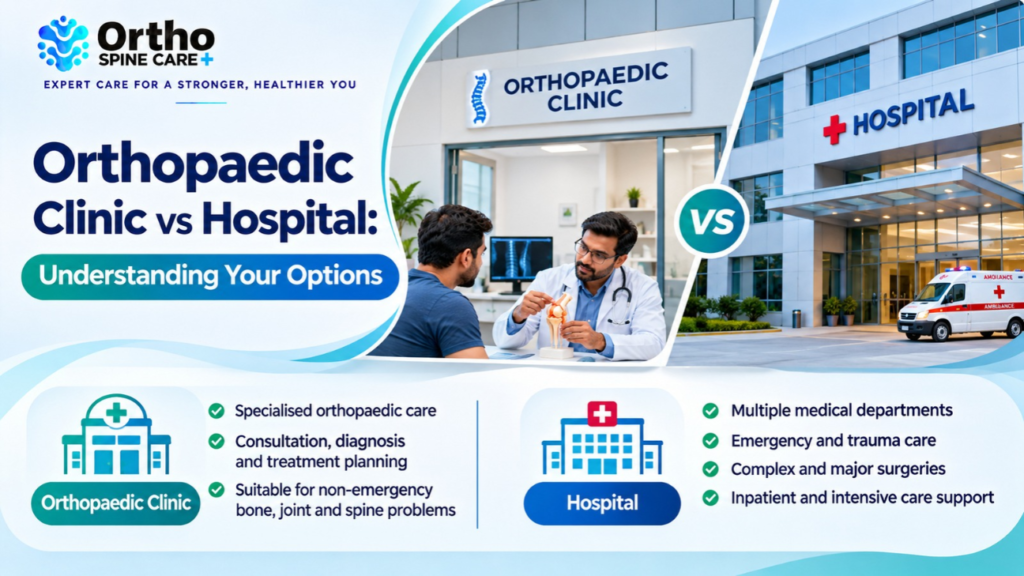
Orthopaedic Clinic vs Hospital: Understanding Your Options
When you experience persistent knee pain, back discomfort, a sports injury, or difficulty moving a joint, one of the first questions you may have is where to seek medical care. Should you visit an orthopaedic clinic or go directly to a hospital?
Both options play an important role in treating bone, joint, muscle, and spine-related conditions. However, they serve different purposes depending on the nature and severity of your symptoms.
For some concerns, an orthopaedic clinic may be a convenient starting point for consultation, diagnosis, and treatment planning. In other situations, particularly emergencies or complex medical conditions, a hospital may be the more appropriate choice.
Understanding the difference can help you make a better-informed decision about your healthcare.
What Is an Orthopaedic Clinic?
An orthopaedic clinic is a specialised healthcare facility that focuses on conditions affecting the musculoskeletal system. This includes bones, joints, muscles, ligaments, tendons, and the spine.
Patients commonly visit orthopaedic clinics for concerns such as:
- Knee, shoulder, hip, and ankle pain
- Back pain and neck discomfort
- Joint stiffness and swelling
- Sports-related injuries
- Fractures and bone-related problems
- Ligament and tendon injuries
- Spine-related conditions
An orthopaedic specialist evaluates your symptoms, examines the affected area, and recommends suitable treatment based on your condition.
Depending on the clinic’s facilities and the doctor’s assessment, treatment may include medication, physiotherapy guidance, rehabilitation, injections, or surgical referral when necessary.
What Is a Hospital?
A hospital is a larger healthcare facility that provides a wider range of medical services. It generally has multiple departments, medical specialists, diagnostic facilities, and emergency care services.
Hospitals are equipped to manage both routine and complex medical conditions. Depending on the facility, they may also provide surgical procedures, inpatient care, intensive care, and post-operative monitoring.
For orthopaedic concerns, hospitals may be required when a patient needs:
- Emergency treatment after a serious accident
- Management of complicated fractures
- Major orthopaedic surgery
- Hospital admission and continuous monitoring
- Treatment involving multiple medical specialists
- Intensive care or other specialised support
Not every hospital offers the same services, so available facilities can vary.
Orthopaedic Clinic vs Hospital: Key Differences
Although both provide medical care, their services and areas of focus can differ.
| Feature | Orthopaedic Clinic | Hospital |
|---|---|---|
| Main focus | Bone, joint, muscle, and spine-related concerns | A wide range of medical conditions |
| Consultation | Specialist-focused appointments | General and specialist consultations |
| Common conditions | Joint pain, back pain, sports injuries, and mobility problems | Routine, complex, and emergency conditions |
| Emergency services | Depends on the facility; generally limited | Emergency services are available at hospitals equipped for them |
| Diagnostic tests | Depends on available facilities | Often offers a wider range of diagnostic services |
| Surgery | May offer selected procedures or refer patients | May provide major and complex surgical care |
| Hospital admission | Usually not available | Available when medically required |
| Follow-up care | Often provides specialist follow-up | May provide post-treatment and inpatient follow-up |
The right choice depends on your symptoms, medical needs, and the services available at the facility.
When Should You Visit an Orthopaedic Clinic?
An orthopaedic clinic can be a suitable first point of contact when you have a bone, joint, muscle, or spine-related concern that needs specialist assessment but does not appear to be an emergency.
Consider scheduling an orthopaedic consultation if you experience the following:
1. Persistent Knee or Joint Pain
Knee pain while walking, climbing stairs, or standing for long periods can affect your daily routine. Similarly, shoulder or hip discomfort may make ordinary movements difficult.
If the pain continues, returns frequently, or gradually becomes worse, an orthopaedic specialist can help evaluate its possible cause.
2. Recurring Back or Neck Pain
Long working hours, repetitive movements, and certain spinal conditions can contribute to back and neck discomfort.
If your symptoms keep returning or affect your ability to sit, stand, or sleep comfortably, consider consulting an orthopaedic or spine specialist.
New bladder or bowel control problems, numbness around the groin or saddle area, or rapidly worsening weakness require emergency assessment rather than a routine clinic appointment.
3. Sports and Activity-Related Injuries
Running, gym workouts, and sports activities can sometimes result in ligament, tendon, or muscle injuries.
An orthopaedic specialist can assess symptoms such as swelling, joint instability, restricted movement, and pain following physical activity.
However, if you suspect a serious fracture or have a visibly deformed limb, seek urgent medical care.
4. Joint Stiffness and Difficulty Moving
Difficulty bending your knee, raising your arm, or walking comfortably may be associated with an underlying joint or muscle condition.
An examination can help identify the problem and determine whether medication, physiotherapy, rehabilitation, or another treatment approach may be appropriate.
When Should You Go Directly to a Hospital?
Some injuries and symptoms require immediate medical attention. In these situations, going directly to a hospital with appropriate emergency facilities is safer than waiting for a routine clinic appointment.
Visit an emergency department if you experience:
- A serious road accident or major physical injury
- A suspected fracture with severe pain or deformity
- Heavy bleeding or an open injury
- Sudden inability to move or put weight on a limb after an injury
- A cold, pale, or numb limb following trauma
- Severe back pain with new bladder or bowel dysfunction, saddle numbness, or rapidly worsening weakness
- Any injury accompanied by loss of consciousness or other serious symptoms
Hospitals can provide emergency assessment, imaging, specialist support, and surgical care when required.
When in doubt about a potentially serious injury, seek urgent medical evaluation rather than delaying care.
Can an Orthopaedic Clinic Refer You to a Hospital?
Yes. An orthopaedic clinic can assess your symptoms and recommend hospital-based care if your condition requires facilities or treatment that the clinic does not provide.
For example, a patient visiting a clinic with persistent knee pain may initially receive a clinical assessment and a treatment plan. If further investigations or surgery are needed, the doctor may recommend appropriate hospital-based services.
Similarly, certain fractures, complicated injuries, or conditions requiring admission may need treatment in a hospital.
The purpose of a specialist consultation is not always to begin treatment immediately. Sometimes, the most important step is identifying the right level of care.
Do Orthopaedic Clinics Provide Surgery?
This depends on the clinic’s facilities, the doctor’s practice, and the type of procedure required.
Some orthopaedic clinics offer selected minor procedures or minimally invasive treatments. Others primarily provide consultations, diagnosis, treatment planning, and follow-up care.
Major operations, procedures requiring general anaesthesia, and surgeries that need inpatient monitoring are generally performed in appropriately equipped hospitals or surgical centres.
Your orthopaedic specialist can explain whether your condition can be managed without surgery or whether a hospital-based procedure should be considered.
It is important to remember that surgery is not necessary for every orthopaedic condition. The decision depends on the diagnosis, severity, response to other treatments, and individual circumstances.
What Should You Consider Before Choosing a Healthcare Facility?
Before deciding where to seek treatment, consider a few important factors.
1. Understand your symptoms
Think about when the pain started, where it occurs, and whether it is affecting your movement or daily activities. Serious or sudden symptoms should be assessed urgently.
2. Check the doctor’s qualifications
Look for a qualified orthopaedic specialist with relevant experience in the condition you are concerned about.
3. Understand the available facilities
Check whether the clinic or hospital provides the consultations, diagnostic tests, emergency support, or procedures you may need.
4. Ask about treatment options
A good consultation should help you understand the possible diagnosis, recommended investigations, treatment choices, and expected follow-up.
5. Consider follow-up care
Musculoskeletal conditions may require ongoing assessment and rehabilitation. Choose a healthcare provider who can guide you through the next steps or coordinate referrals when needed.
Orthopaedic Care at OrthoSpineCare, Bangalore
For people experiencing bone, joint, and spine-related concerns in Bangalore, choosing a specialist who can evaluate their symptoms and explain suitable treatment options is an important first step.
OrthoSpineCare, located in Sadashivanagar, Bangalore, provides orthopaedic and spine-related consultations under the care of Dr. Prajwal GS, Orthopaedic and Spine Surgeon.
The clinic focuses on evaluating concerns such as:
- Spine conditions and back pain
- Bone and joint problems
- Fractures and trauma-related concerns
- Sports injuries
- Musculoskeletal pain and mobility difficulties
- Orthopaedic treatment and rehabilitation guidance
Patients can discuss their symptoms, understand the available treatment options, and receive guidance on whether further investigations or hospital-based care may be necessary.
The appropriate treatment plan is determined after an individual medical assessment.
Final Thoughts: Which Option Is Right for You?
An orthopaedic clinic and a hospital both play valuable roles in musculoskeletal healthcare. The difference lies mainly in the type of care required.
If you have persistent joint pain, recurring back discomfort, stiffness, or a sports-related injury that is not an emergency, an orthopaedic clinic can be a practical starting point.
On the other hand, serious accidents, major injuries, suspected complicated fractures, and emergency symptoms require immediate hospital-based care.
Rather than delaying treatment or choosing a facility based only on convenience, focus on the severity of your symptoms and the medical support you need.
Getting the right assessment at the right time can help you understand your condition and make informed decisions about your bone, joint, and spine health.
If you are experiencing ongoing orthopaedic or spine-related discomfort in Bangalore, consider consulting OrthoSpineCare for a specialist evaluation.
Medical Disclaimer: This article is for general educational purposes and does not replace professional medical advice, diagnosis, or treatment. The appropriate healthcare facility depends on the severity of symptoms and the services available. Seek emergency care for serious injuries or warning signs.