
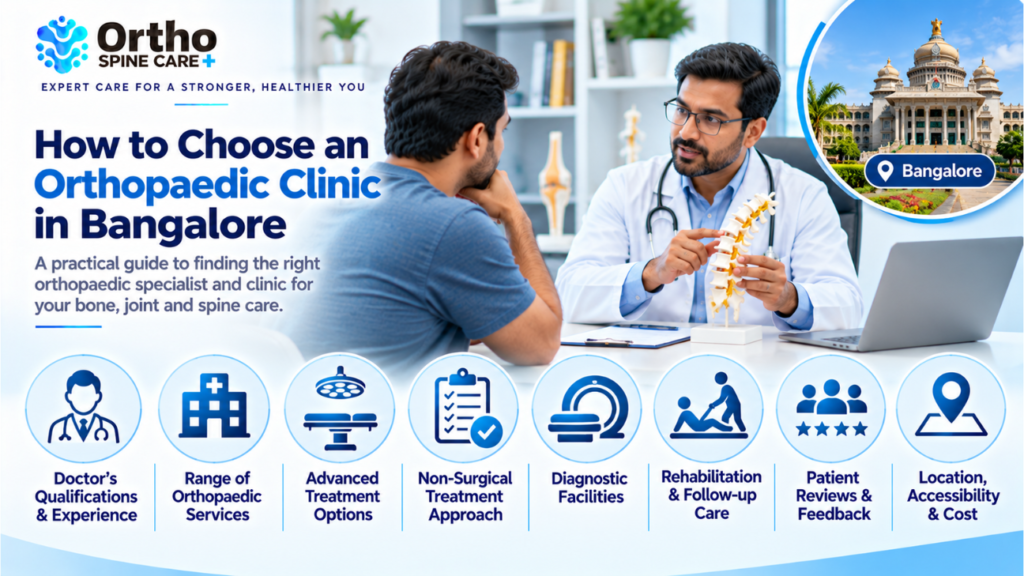
How to Choose an Orthopaedic Clinic in Bangalore
Choosing the right orthopaedic clinic is an important decision, especially when bone, joint, or muscle problems begin affecting your everyday life. Whether you are experiencing persistent knee pain, back discomfort, a sports injury, or difficulty walking, getting the right medical attention can make a significant difference to your recovery.
However, with so many hospitals, clinics, and specialists available in Bangalore, finding the right place for orthopaedic treatment can sometimes feel confusing.
You may wonder whether a clinic has experienced doctors, offers advanced treatment options, provides proper rehabilitation, or focuses on understanding each patient’s individual needs.
The truth is that choosing an orthopaedic clinic should involve more than simply looking at its location or consultation fees. It is important to consider the doctor’s qualifications, available facilities, treatment approach, and the quality of patient care.
If you are searching for an orthopaedic clinic in Bangalore, this guide will help you understand what to look for before making your decision.
1. Check the Qualifications and Experience of the Orthopaedic Doctor
One of the first things to consider when choosing an orthopaedic clinic is the doctor’s qualifications and professional experience.
Orthopaedics is a specialized medical field that deals with conditions affecting bones, joints, muscles, ligaments, tendons, and the spine.
Depending on your condition, you may need a general orthopaedic specialist or a doctor with additional expertise in areas such as spine surgery, joint replacement, sports injuries, or trauma care.
Before booking an appointment, consider checking:
- The doctor’s medical qualifications.
- Postgraduate specialization in orthopaedics.
- Additional fellowships or specialist training.
- Experience treating your particular condition.
- Areas of clinical interest and specialization.
For example, if you are experiencing persistent lower back pain or sciatica, consulting an orthopaedic surgeon with specialist training in spine surgery may be appropriate.
Similarly, patients experiencing recurring knee pain or sports-related ligament injuries may benefit from consulting a specialist experienced in those conditions.
If you are unsure whether your symptoms require specialist attention, understanding when to visit an orthopaedic doctor can help you decide when to seek medical evaluation.
2. Look for a Clinic That Treats Different Orthopaedic Conditions
Orthopaedic problems can affect different parts of the body, and each condition may require a different treatment approach.
Therefore, choosing a clinic that evaluates a range of bone, joint, and spine conditions can be beneficial.
Orthopaedic specialists manage a wide range of conditions affecting bones, joints, muscles, and ligaments. Explore these common orthopaedic conditions to understand the problems that may require specialist care.
Some common conditions treated by orthopaedic specialists include:
Bone and Joint Problems
- Knee pain
- Hip pain
- Shoulder pain
- Osteoarthritis
- Joint stiffness
- Degenerative joint conditions
Spine-Related Conditions
- Slipped or herniated discs
- Sciatica
- Cervical spondylosis
- Lumbar spondylosis
- Spinal stenosis
- Nerve compression
Sports Injuries
- Ligament tears
- Muscle injuries
- Tendon injuries
- Rotator cuff problems
- Sports-related joint injuries
Fractures and Trauma
- Bone fractures
- Joint dislocations
- Accident-related injuries
- Soft tissue injuries
Before selecting a clinic, check whether its doctors have the appropriate experience and expertise for your particular problem.
Conditions such as arthritis, ligament injuries, fractures, and joint disorders can affect everyday movement. Read more about common bone and joint problems and the treatment approaches available.
3. Consider the Availability of Advanced Treatment Options
Medical technology and treatment techniques have improved significantly over the years.
Today, many orthopaedic conditions can be managed using a combination of medication, physiotherapy, minimally invasive procedures, and surgical treatments when necessary.
A good orthopaedic clinic should be able to evaluate your condition and discuss suitable treatment options.
Depending on the clinic’s facilities and specialist expertise, these may include:
- Non-surgical pain management
- Physiotherapy and rehabilitation guidance
- Joint preservation treatments
- Minimally invasive orthopaedic procedures
- Spine surgery
- Fracture management
- Sports injury treatment
For example, selected patients with a herniated disc may benefit from conservative treatment, while others with significant nerve compression may require surgical evaluation.
The important thing is to choose a specialist who considers your diagnosis and individual needs rather than recommending the same treatment for every patient.
4. Check Whether the Clinic Prioritizes Non-Surgical Treatment
Not every orthopaedic problem requires surgery.
In fact, many conditions involving back pain, knee discomfort, joint stiffness, and muscle injuries may initially improve with appropriate non-surgical treatments.
Depending on the diagnosis, your doctor may recommend:
- Medication when appropriate
- Physiotherapy
- Strengthening exercises
- Activity modification
- Posture correction
- Rehabilitation
- Selected pain management procedures
For instance, patients experiencing certain types of lower back pain may improve through guided exercises and suitable conservative treatment.
However, surgery may be necessary for certain fractures, significant nerve compression, severe structural problems, or conditions that do not respond adequately to appropriate non-surgical care.
Therefore, look for a clinic that explains both surgical and non-surgical options and helps you understand the potential benefits and limitations of each approach.
Depending on your symptoms and diagnosis, you may need an orthopaedic surgeon, a physiotherapist, or both. Learn more about the differences between an orthopaedic surgeon and physiotherapist before deciding which specialist to consult.
5. Evaluate the Diagnostic Facilities and Medical Assessment
Accurate diagnosis is the foundation of effective orthopaedic treatment.
Although symptoms may appear similar, their underlying causes can be different.
For example, knee pain may result from arthritis, ligament injuries, cartilage problems, or other conditions. Similarly, lower back pain may be related to muscles, spinal discs, joints, or compressed nerves.
A proper evaluation generally involves:
Medical History: The doctor understands when your symptoms started, their severity, and how they affect your daily activities.
Physical Examination: The specialist checks joint movement, muscle strength, flexibility, sensation, and other relevant findings.
X-rays: These help assess bones, joint alignment, and certain structural abnormalities.
MRI Scans: These provide detailed images of soft tissues, spinal discs, ligaments, and nerves.
CT Scans: These may be useful for evaluating complex bone injuries and structural problems.
Not every patient requires every investigation. Your doctor should recommend tests based on your symptoms and clinical examination.
Also, check whether the clinic has access to appropriate diagnostic facilities or coordinates with reliable imaging centres when necessary.
6. Look at Patient Reviews and Feedback
Patient feedback can offer useful information when comparing orthopaedic clinics.
Although online reviews should not be the only factor in your decision, they can help you understand other patients’ experiences.
When reading reviews, look for comments about:
- Doctor communication
- Appointment experience
- Explanation of medical conditions
- Treatment planning
- Staff behaviour
- Follow-up support
- Clinic cleanliness and organization
Pay attention to detailed feedback rather than relying only on star ratings.
For example, reviews mentioning that a doctor explained the diagnosis clearly or discussed different treatment options may help you understand the clinic’s approach to patient communication.
However, remember that individual experiences vary, and reviews cannot guarantee a particular medical outcome.
7. Check the Location and Accessibility of the Clinic
Location is another practical factor when choosing an orthopaedic clinic in Bangalore.
If you require multiple consultations, follow-up appointments, or rehabilitation sessions, travelling long distances may become inconvenient.
Consider choosing a clinic that is reasonably accessible from your home or workplace.
You may want to check:
- Distance from your location
- Availability of public transportation
- Parking facilities
- Appointment availability
- Accessibility for elderly patients
- Convenience for follow-up visits
For patients experiencing mobility difficulties, easy access to the clinic can make the treatment process more comfortable.
If you are located in North Bangalore, considering clinics around Sadashivanagar and nearby areas may help reduce travel time.
8. Understand the Consultation Fees and Treatment Costs
Medical expenses are another important consideration.
Orthopaedic treatment costs can vary depending on the doctor’s specialization, investigations, treatment methods, and the complexity of the condition.
Before beginning treatment, ask about the expected expenses.
Consider checking:
- Initial consultation fees
- Follow-up consultation charges
- Diagnostic investigation costs
- Physiotherapy expenses
- Medication costs
- Procedure or surgery charges
- Hospitalization expenses, if required
If surgery is recommended, ask for a clear cost estimate that includes the surgeon’s fees, hospital charges, anaesthesia, implants where applicable, and postoperative care.
Additionally, if you have health insurance, check whether the relevant treatment and hospital are covered under your policy.
A transparent discussion about costs can help you plan your treatment without unexpected financial concerns.
9. Look for Proper Rehabilitation and Follow-Up Support
Orthopaedic treatment does not always end once the initial pain improves.
Depending on your condition, rehabilitation may be an important part of regaining strength, movement, and confidence.
For example, patients recovering from fractures, ligament injuries, joint procedures, or spine surgery may require a structured rehabilitation plan.
A suitable rehabilitation programme may focus on:
- Improving flexibility
- Strengthening muscles
- Restoring joint movement
- Improving balance
- Increasing walking ability
- Gradually returning to everyday activities
Follow-up appointments are also important because they allow the doctor to monitor your progress and modify the treatment plan when necessary.
Therefore, before choosing a clinic, understand how postoperative care, rehabilitation guidance, and follow-up consultations are managed.
10. Choose a Clinic That Communicates Clearly With Patients
Good communication is an important part of medical care.
Patients should feel comfortable discussing their symptoms, concerns, and treatment preferences with their doctor.
During your first consultation, notice whether the doctor:
- Listens carefully to your symptoms.
- Explains the possible causes of your condition.
- Discusses investigation findings.
- Explains available treatment options.
- Clarifies potential risks and benefits.
- Answers your questions patiently.
- Provides realistic recovery expectations.
For example, if surgery is recommended, you should understand why it is necessary, whether alternatives are available, and what recovery may involve.
A patient-centred approach helps you participate more confidently in decisions about your healthcare.
If you are uncertain about which specialist to approach, understanding whether to consult an orthopaedic doctor or general physician can help you choose the right starting point for your healthcare needs.
11. Questions to Ask Before Choosing an Orthopaedic Clinic
Before finalizing your decision, consider asking the following questions during your consultation:
- Does the doctor specialize in my particular condition?
- What is causing my symptoms?
- What investigations are necessary?
- Are non-surgical treatments available?
- What treatment options are suitable for me?
- Will I need physiotherapy or rehabilitation?
- How long might recovery take?
- What are the potential risks of the recommended treatment?
- How frequently will I need follow-up appointments?
- What will the expected treatment cost be?
These questions can help you understand the clinic’s approach and make a more informed decision.
Preparing for your appointment can make your visit more productive. Read our guide on what to expect during your first orthopaedic consultation so you know how to prepare and what information to discuss with your doctor.
12. Why Choosing the Right Orthopaedic Clinic Matters
Orthopaedic conditions can affect your mobility, independence, work, and overall quality of life.
For instance, persistent knee pain may make climbing stairs difficult, while a spinal condition may interfere with sitting, walking, or sleeping comfortably.
Choosing an appropriate clinic can help you receive:
- Proper medical evaluation
- Accurate diagnosis
- Individualized treatment planning
- Access to suitable treatment options
- Rehabilitation guidance
- Continued medical follow-up
Most importantly, early evaluation may help identify certain conditions before they become more complicated.
However, the best clinic is not necessarily the one offering the most procedures or the newest technology. It is the one with appropriate medical expertise and a treatment approach suited to your individual needs.
Orthopaedic Care at OrthoSpineCare, Sadashivanagar, Bangalore
If you are searching for an orthopaedic clinic in Bangalore, OrthoSpineCare offers orthopaedic and spine care under the guidance of Dr. Prajwal GS.
Located in Sadashivanagar, North Bangalore, the clinic focuses on evaluating and managing conditions affecting the bones, joints, and spine.
Dr. Prajwal GS is an Orthopaedic and Spine Surgeon. According to the clinic’s listed profile, his qualifications include:
- MBBS – Kempegowda Institute of Medical Sciences, Bangalore
- MS Orthopaedics – J.J.M. Medical College, Davanagere
- Fellowship in Spine Surgery – Mallika Spine Centre, Guntur
- Fellowship in Minimally Invasive Spine Surgery – Mumbai
- Fellowship in Orthopaedic Rheumatology
- AO Global Spine Diploma – AO Spine, Davos, Switzerland
Services Listed at OrthoSpineCare
Spine Care: Evaluation and treatment of slipped discs, sciatica, spinal disorders, and related conditions.
Bone and Joint Treatments: Care for joint pain, arthritis, and musculoskeletal conditions.
Fracture and Trauma Care: Management of fractures, injuries, and trauma-related orthopaedic problems.
Sports Injury Management: Evaluation and treatment of selected ligament, tendon, and sports-related injuries.
Minimally Invasive Procedures: Surgical approaches for suitable orthopaedic and spinal conditions.
Pain Management and Rehabilitation Guidance: Treatment planning and recovery support based on individual patient requirements.
The clinic emphasizes accurate diagnosis, personalized treatment planning, and consideration of both surgical and non-surgical approaches.
Book an Orthopaedic Consultation
If you are experiencing persistent joint pain, back pain, difficulty walking, or other orthopaedic symptoms, consider arranging an evaluation to understand the underlying cause.
OrthoSpineCare
Address: No. 2, 10th Cross Road, Sadashivanagar, Bangalore – 560080 (Near Rashtrotthana Yoga Centre)
Phone: 9740559577
Email: prajwalgs1894@gmail.com
Website: https://orthospinecare.in/
Final Thoughts
Choosing the right orthopaedic clinic in Bangalore is an important step towards managing bone, joint, and spine problems.
Rather than making a decision based only on location, cost, or online ratings, take time to evaluate the doctor’s qualifications, specialist experience, available treatment options, diagnostic approach, and rehabilitation support.
A good orthopaedic consultation should help you understand your condition, explore suitable treatments, and make informed decisions about your health.
Remember, not every orthopaedic problem requires surgery. Many conditions can improve with appropriate non-surgical treatment, while others may need specialist intervention.
If joint pain, back discomfort, or mobility problems are affecting your daily life, consulting a qualified orthopaedic specialist can help you take the right next step towards better movement and improved quality of life.
Medical Disclaimer: This article is intended for general educational purposes only and does not replace professional medical advice, diagnosis, or treatment. Treatment recommendations depend on individual symptoms, examination findings, medical history, and clinical circumstances.