
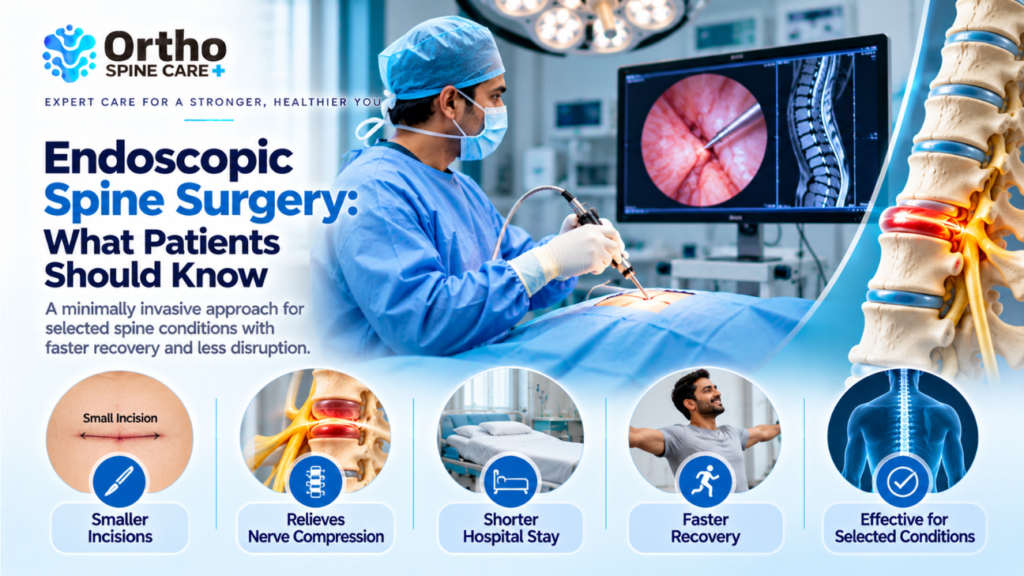
Endoscopic Spine Surgery: What Patients Should Know
Persistent back pain, neck pain, or discomfort that travels down your arms or legs can make everyday life difficult. Simple activities such as sitting, walking, bending, driving, or sleeping may become uncomfortable when a spinal condition affects your movement.
Although many spine-related problems improve with medication, physiotherapy, and other non-surgical treatments, some conditions may require surgery. Fortunately, advances in surgical techniques have introduced different approaches to treating spinal problems, including Endoscopic Spine Surgery.
This technique uses a small camera and specialized instruments to access and treat selected spinal conditions through relatively small incisions.
But what exactly is endoscopic spine surgery? Who may benefit from it, and how long does recovery take?
If you are looking for a spine surgeon in Bangalore, understanding this procedure can help you have a more informed discussion with your doctor.
What Is Endoscopic Spine Surgery?
Endoscopic spine surgery is a minimally invasive surgical technique used to treat certain conditions affecting the spinal discs and nearby nerves.
During the procedure, the surgeon uses a thin instrument called an endoscope, which contains a small camera and lighting system. This allows the surgeon to view the affected area on a monitor while performing the required treatment using specialized instruments.
Unlike many traditional open procedures, endoscopic techniques are designed to access the affected spinal structures through a small incision while limiting unnecessary disruption to surrounding muscles and tissues.
Depending on the patient’s condition, the surgeon may remove problematic disc material or relieve pressure on compressed nerves.
The main objective is to address the underlying spinal problem while minimizing damage to surrounding structures.
However, endoscopic surgery is not suitable for every spinal condition. The decision depends on the diagnosis, location of the problem, anatomy, and overall health of the patient.
Which Spine Conditions Can Be Treated With Endoscopic Surgery?
Endoscopic spine surgery may be considered for selected conditions involving disc problems and nerve compression.
Let’s understand some common conditions where this approach may be discussed.
1. Herniated or Slipped Disc
A herniated disc occurs when the soft inner material of a spinal disc pushes through its outer covering. Depending on its location, the displaced material may irritate or compress nearby nerves.
This can result in:
- Lower back or neck pain
- Pain travelling into the leg or arm
- Tingling sensations
- Numbness
- Muscle weakness
When appropriate non-surgical treatments have not provided sufficient improvement, an endoscopic discectomy may be considered to remove the problematic disc material and relieve nerve pressure.
2. Sciatica
Sciatica refers to pain that travels along the sciatic nerve, usually from the lower back through the buttock and into the leg.
It is commonly associated with irritation or compression of nerve roots in the lower spine.
Although many cases improve with conservative treatment, persistent symptoms caused by a suitable structural problem may require surgical evaluation.
In selected patients, endoscopic surgery may help address the source of nerve compression.
3. Lumbar Disc Prolapse
Lumbar disc prolapse occurs when disc material in the lower back protrudes and may put pressure on nearby nerves.
Depending on the severity, patients may experience back pain, leg pain, numbness, or difficulty performing everyday activities.
If the condition does not respond adequately to appropriate conservative treatment, your spine surgeon may consider whether an endoscopic procedure is suitable.
4. Selected Cases of Spinal Stenosis
Spinal stenosis occurs when spaces within the spinal canal or nerve passageways become narrower, potentially placing pressure on nearby nerves.
Some patients experience pain, numbness, weakness, or difficulty walking.
In selected cases, endoscopic decompression may be considered to create more space for compressed nerves.
However, not every type of spinal stenosis can be treated endoscopically. The extent and location of narrowing are important when deciding on the surgical approach.
How Is Endoscopic Spine Surgery Performed?
The exact procedure depends on the spinal condition being treated. Nevertheless, most endoscopic procedures follow a few general steps.
Step 1: Pre-Surgical Assessment
Before recommending surgery, your doctor reviews your symptoms, medical history, physical examination, and relevant imaging reports.
MRI scans are particularly useful for assessing disc problems and nerve compression, while X-rays or CT scans may provide additional information when necessary.
Your doctor also evaluates your overall health and determines whether surgery is appropriate.
Step 2: Anaesthesia
The anaesthesia plan depends on the procedure, patient, and clinical circumstances. Many endoscopic spine procedures are performed under general anaesthesia, although other approaches may be suitable in selected cases.
Throughout the procedure, the medical team monitors the patient’s vital signs.
Step 3: Making a Small Incision
The surgeon makes a small incision near the affected spinal area.
Through this opening, a specialized endoscope is carefully guided towards the target area.
The camera provides magnified images of the spinal structures on a monitor, allowing the surgeon to visualize the affected region.
Step 4: Treating the Problem
Using specialized instruments, the surgeon performs the required treatment.
For example, in an endoscopic discectomy, problematic disc material may be removed to relieve pressure on a nearby nerve.
In selected cases of spinal stenosis, the surgeon may perform decompression to create additional space around the affected nerves.
Step 5: Closing the Incision
Once the procedure is completed, the instruments are removed and the incision is closed.
The patient is then moved to the recovery area for observation and postoperative care.
What Are the Benefits of Endoscopic Spine Surgery?
One of the main reasons endoscopic spine surgery is considered is its ability to access selected spinal structures through a relatively small incision.
Depending on the procedure and patient’s condition, potential benefits may include:
1. Smaller Incisions
Endoscopic procedures generally use small surgical incisions compared with many conventional open operations.
Consequently, the surgical wound may be smaller and the resulting scar less noticeable.
2. Less Muscle Disruption
Traditional open spine surgery may require greater separation of the muscles surrounding the spine.
Endoscopic techniques are designed to access the affected area while minimizing unnecessary disruption to these tissues.
This may help reduce postoperative muscle discomfort in suitable patients.
3. Reduced Blood Loss
Because the procedure generally involves smaller access incisions and less tissue disruption, blood loss may be lower in selected cases compared with conventional approaches.
However, the actual amount depends on the complexity of the procedure and individual circumstances.
4. Potentially Shorter Hospital Stay
Some patients can return home on the same day or after a short hospital stay, depending on the procedure and their recovery.
Nevertheless, discharge depends on pain control, mobility, medical stability, and the surgeon’s assessment.
5. Faster Initial Recovery
Since endoscopic surgery is designed to minimize tissue disruption, some patients may experience a quicker initial recovery.
This may help them gradually resume everyday activities sooner than with certain conventional procedures.
However, complete healing and recovery still take time.
6. Targeted Treatment
The endoscope provides magnified visualization of the surgical area.
This allows the surgeon to work around the targeted spinal structures using specialized instruments.
The suitability and effectiveness of this approach depend on the specific condition and the surgeon’s assessment.
Endoscopic Spine Surgery vs Traditional Open Spine Surgery
Both surgical approaches are used to treat spinal conditions, but they differ in how the surgeon reaches the affected area.
| Feature | Endoscopic Spine Surgery | Traditional Open Surgery |
|---|---|---|
| Incision | Very small incision | Generally larger incision |
| Visualization | Camera and monitor | Direct surgical exposure |
| Instruments | Specialized endoscopic instruments | Conventional surgical instruments |
| Muscle disruption | Designed to minimize disruption | May involve greater muscle separation |
| Blood loss | May be lower in selected cases | May be higher in some procedures |
| Recovery | May allow faster initial recovery | Depends on the procedure and extent of surgery |
| Suitability | Selected spinal conditions | Selected and complex spinal conditions |
It is important to understand that endoscopic surgery is not automatically the best option for everyone.
Some spinal problems require a different surgical approach to achieve adequate treatment. Therefore, the choice should always be based on the patient’s diagnosis and expected surgical outcome.
How Long Does Recovery Take After Endoscopic Spine Surgery?
Recovery is one of the first things patients want to understand before undergoing spine surgery.
Although endoscopic procedures may allow faster initial recovery in selected patients, the actual healing period varies from person to person.
Factors that influence recovery include:
- The spinal condition being treated
- The type of endoscopic procedure
- The severity of nerve compression
- Your general health
- Your age and physical fitness
- Whether additional spinal procedures were performed
- Your response to rehabilitation
Some patients may begin walking within hours of surgery, while others require additional monitoring.
Your surgeon will provide a recovery plan based on the procedure and your individual progress.
Understanding the Recovery Stages
First 24–48 Hours
After surgery, the medical team monitors your condition, pain levels, wound, and ability to move safely.
Depending on your progress, you may be encouraged to stand and walk with assistance.
You will also receive instructions about medication, wound care, and activities to avoid.
First Few Weeks
During the initial recovery period, you may gradually return to suitable daily activities.
However, heavy lifting, repetitive bending, twisting, and strenuous exercise may need to be restricted temporarily.
Even if your pain improves quickly, avoid returning to demanding activities without medical clearance.
Rehabilitation and Strengthening
Depending on the procedure, your doctor may recommend physiotherapy or a structured rehabilitation programme.
This may include gentle movement, flexibility exercises, and gradual strengthening.
Rehabilitation can help improve physical function and support a safe return to everyday activities.
Returning to Work and Exercise
The time required to resume work depends on your job and the type of surgery performed.
For example, someone with a desk-based job may return earlier than someone whose work involves heavy lifting or prolonged physical activity.
Similarly, returning to sports or gym workouts requires appropriate recovery and medical clearance.
Is Endoscopic Spine Surgery Safe?
Like every surgical procedure, endoscopic spine surgery has potential risks.
Although the technique is designed to minimize tissue disruption, it does not eliminate surgical complications.
Possible risks include:
- Infection
- Bleeding
- Nerve irritation or injury
- Dural tear or spinal fluid leakage
- Persistent or recurring symptoms
- Incomplete relief of pain
- Anaesthesia-related complications
- Need for additional treatment or surgery
The likelihood of complications depends on the procedure, the patient’s condition, and other medical factors.
Before proceeding, your surgeon should explain the expected benefits, potential risks, alternatives, and recovery requirements.
Is Endoscopic Spine Surgery Suitable for Everyone?
No. Although endoscopic techniques are useful for selected spinal conditions, they are not appropriate for every patient.
Your surgeon may consider this approach when:
- There is an identifiable disc or nerve-related problem.
- Symptoms are significantly affecting daily activities.
- Appropriate non-surgical treatment has not provided sufficient improvement, where relevant.
- The affected area can be safely accessed using an endoscopic technique.
- The expected benefits outweigh the potential risks.
On the other hand, extensive spinal deformities, certain unstable conditions, complex injuries, or other structural problems may require a different surgical approach.
In addition, many patients with disc problems or sciatica can improve without surgery.
An individual assessment is therefore essential before deciding on an operation.
What Should You Ask Your Spine Surgeon Before Surgery?
Before agreeing to endoscopic spine surgery, make sure you understand the procedure and why it has been recommended.
Here are some useful questions to ask:
- What exactly is causing my symptoms?
- Why is endoscopic surgery being recommended?
- Can my condition improve without surgery?
- Am I suitable for an endoscopic procedure?
- What are the potential risks and benefits?
- How long might recovery take?
- Will I need physiotherapy after surgery?
- When can I return to work and normal activities?
- What happens if the procedure does not provide sufficient relief?
These questions can help you understand your treatment options and make an informed decision.
If you remain uncertain about major surgery, you may also consider seeking a second opinion from another qualified spine specialist, provided there is no urgent need for intervention.
When Should You Consult a Spine Surgeon?
You should consider a specialist evaluation if you experience:
- Persistent lower back or neck pain
- Pain travelling from your back into your leg
- Recurring sciatica
- Numbness or tingling in your arms or legs
- Muscle weakness
- Difficulty walking comfortably
- A diagnosed slipped disc with persistent symptoms
- Spine-related pain that has not improved with appropriate treatment
However, certain symptoms require emergency medical attention.
New loss of bladder or bowel control, numbness around the groin or saddle area, or rapidly worsening weakness alongside back pain may indicate serious nerve compression. Seek emergency medical evaluation rather than waiting for a routine appointment.
Endoscopic Spine Care at OrthoSpineCare, Bangalore
Choosing the right spine specialist is an important part of understanding your condition and available treatment options.
If you are looking for a spine surgeon in Bangalore, consider the doctor’s qualifications, specialist training, experience, and approach to both surgical and non-surgical treatment.
OrthoSpineCare, located in Sadashivanagar, Bangalore, provides orthopaedic and spine care under Dr. Prajwal GS.
Dr. Prajwal GS’s listed qualifications include:
- MBBS – Kempegowda Institute of Medical Sciences, Bangalore
- MS Orthopaedics – J.J.M. Medical College, Davanagere
- Fellowship in Spine Surgery – Mallika Spine Centre, Guntur
- Fellowship in Minimally Invasive Spine Surgery – Mumbai
- Fellowship in Orthopaedic Rheumatology
- AO Global Spine Diploma – AO Spine, Davos, Switzerland
The clinic’s listed services include spine care, minimally invasive spine procedures, fracture and trauma management, bone and joint treatment, sports injury management, pain management, and rehabilitation guidance.
If you have persistent back pain, sciatica, or a diagnosed disc problem, an individual consultation can help you understand your condition and whether endoscopic surgery or another treatment approach may be appropriate.
Book a Consultation
OrthoSpineCare
No. 2, 10th Cross Road, Sadashivanagar, Bangalore – 560080
Phone: 9740559577
Final Thoughts
Endoscopic spine surgery is an advanced minimally invasive technique that may help treat selected spinal conditions, particularly certain disc problems and nerve compression.
With the use of a small camera and specialized instruments, it allows surgeons to access the affected area through relatively small incisions while aiming to minimize disruption to surrounding tissues.
However, surgery is not necessary for every patient with back pain or a slipped disc. Depending on the diagnosis, medication, physiotherapy, rehabilitation, and other non-surgical treatments may be sufficient.
The most important step is to understand the cause of your symptoms and discuss the available treatment options with a qualified spine specialist.
If persistent back pain, neck pain, or sciatica is affecting your everyday life, consider seeking a professional evaluation to understand which treatment may be right for you.
This article is intended for general educational purposes and does not replace an individual medical consultation. Treatment recommendations depend on the patient’s diagnosis, symptoms, examination findings, medical history, investigations, and clinical circumstances.