
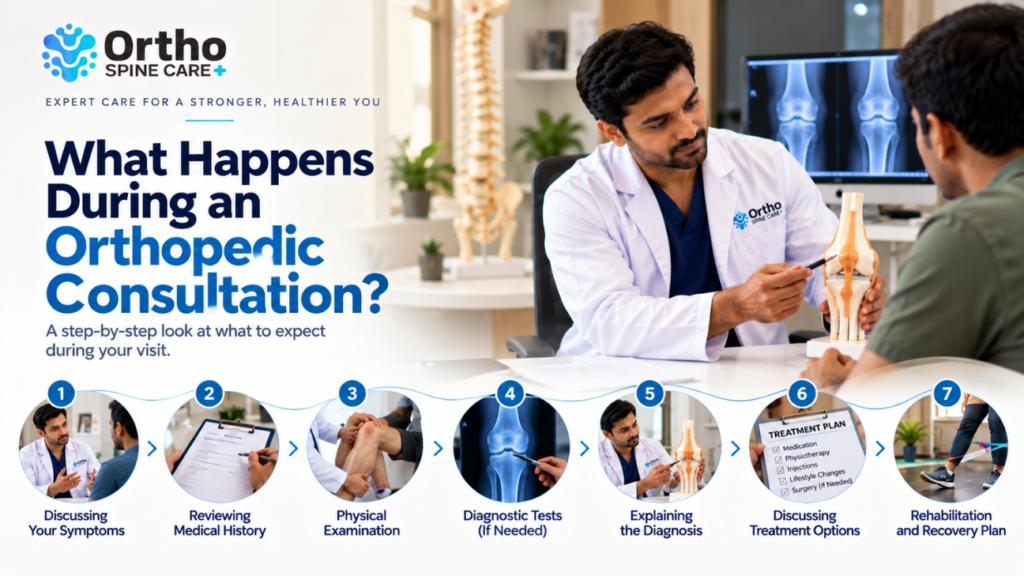
What Happens During an Orthopedic Consultation?
Visiting an orthopedic doctor for the first time can feel a little uncertain, especially if you don’t know what will happen during the appointment.
You may be visiting because of persistent knee pain, back pain, a sports injury, joint stiffness, a fracture, or difficulty moving normally. You may also be wondering whether you need an X-ray, physiotherapy, medication, or even surgery.
An orthopedic consultation is usually the first step toward understanding what is causing your symptoms and which treatment options may be suitable for you.
If you are looking for an orthopedic doctor in Bangalore, knowing what to expect during your consultation can help you feel more comfortable and prepared.
What Is an Orthopedic Consultation?
An orthopedic consultation is an evaluation of problems affecting the musculoskeletal system.
This includes:
- Bones
- Joints
- Muscles
- Ligaments
- Tendons
- Spine
Depending on your symptoms, an orthopedic doctor may evaluate conditions such as joint pain, fractures, sports injuries, spine problems, arthritis, ligament injuries, and other musculoskeletal conditions.
At OrthoSpineCare, care includes spine conditions, fractures and trauma, bone and joint problems, sports injuries, pain management, rehabilitation, diagnostic services, and surgical treatment.
1. The Consultation Usually Starts With Your Symptoms
The first part of the appointment is generally a conversation about what you are experiencing.
Your doctor may ask:
- Where exactly do you have pain?
- When did it begin?
- Did it start after an injury?
- Is the pain constant or occasional?
- What activities make it worse?
- Does anything make it better?
- Do you have swelling or stiffness?
- Has your movement become restricted?
- Does the pain affect your sleep or daily activities?
Try to describe your symptoms as clearly as possible.
You don’t need to know the medical terminology. Simply explaining what you feel and when you experience it can give your doctor useful information.
For example, instead of saying only, “My knee hurts,” you could explain that the pain becomes worse while climbing stairs or getting up from a chair.
2. Your Medical History Is Discussed
Your previous medical history can provide important context.
Your orthopedic doctor may ask about:
- Previous injuries
- Previous surgeries
- Existing medical conditions
- Current medications
- Previous treatments
- Earlier X-rays or scans
- Physiotherapy or rehabilitation
- Similar problems you’ve experienced before
If you have previous medical reports, scans, or prescriptions, it is useful to bring them to your appointment.
3. The Doctor Performs a Physical Examination
After discussing your symptoms, your doctor may examine the affected area.
The exact examination depends on your problem.
For a knee problem, the doctor may assess:
- Range of motion
- Swelling
- Tenderness
- Joint stability
- Movement
For a shoulder problem, the doctor may assess:
- Shoulder movement
- Strength
- Range of motion
- Tenderness
For back or neck problems, the examination may include assessing movement, strength, sensation, and other relevant findings.
The purpose is to understand how the affected area is functioning and identify findings that may help explain your symptoms.
4. Your Movement May Be Assessed
Movement can provide useful information about many orthopedic conditions.
Your doctor may ask you to perform simple movements such as:
- Bending or straightening a joint
- Walking
- Raising an arm
- Rotating your shoulder
- Bending your back
- Moving your neck
The doctor may observe whether a particular movement causes pain, stiffness, weakness, or restricted movement.
This can help narrow down the possible cause of your symptoms.
5. You May Need Diagnostic Tests
Not everyone who visits an orthopedic doctor needs an X-ray or scan.
Whether you need an investigation depends on your symptoms, medical history, and physical examination.
When appropriate, your doctor may recommend diagnostic tests to understand the problem more clearly.
OrthoSpineCare lists digital X-rays, standing X-rays for spine and joint analysis, and bone-density/DEXA scan guidance among its diagnostic services.
The purpose of these investigations is to provide additional information that can help with diagnosis and treatment planning.
6. Your Doctor Explains the Possible Diagnosis
Once your symptoms, medical history, physical examination, and relevant investigations have been considered, your doctor can explain what may be causing the problem.
This is an important part of the consultation.
For example, knee pain can have different causes, while back pain may be associated with different spine or musculoskeletal conditions.
Understanding the underlying problem helps your doctor determine what treatment options may be appropriate.
7. Your Treatment Options Are Discussed
Orthopedic treatment does not automatically mean surgery.
Depending on your condition, your doctor may discuss options such as:
- Medication
- Physiotherapy
- Exercise and rehabilitation
- Activity modification
- Pain management
- Injections
- Lifestyle changes
- Minimally invasive procedures
- Surgery when appropriate
At OrthoSpineCare, both non-surgical and surgical approaches are available across its listed orthopaedic and spine services.
The appropriate treatment depends on your diagnosis, symptoms, examination findings, and individual circumstances.
8. You Can Ask Whether Surgery Is Necessary
If surgery is being discussed, don’t hesitate to ask questions.
You can ask:
“Why do I need surgery?”
“Are there non-surgical options?”
“What happens if I wait?”
“What are the expected benefits?”
“How long could recovery take?”
Orthopedic surgery may be appropriate for selected fractures, joint conditions, ligament injuries, spine problems, and other conditions.
However, surgery is not automatically required simply because you have persistent pain.
9. Physiotherapy and Rehabilitation May Be Recommended
For many orthopedic conditions, treatment doesn’t end with medication or a procedure.
Physiotherapy and rehabilitation can help work toward:
- Better strength
- Improved flexibility
- Greater range of motion
- Improved balance
- Better joint function
- Recovery after injury
- Recovery after surgery
OrthoSpineCare provides physiotherapy and rehabilitation guidance for post-injury recovery and post-surgical rehabilitation.
Your doctor can explain whether rehabilitation is appropriate for your condition and what your recovery plan may involve.
10. You Can Discuss Your Daily Activities
An orthopedic consultation should also consider how your condition affects your everyday life.
Tell your doctor if your symptoms are making it difficult to:
- Walk
- Climb stairs
- Exercise
- Work
- Drive
- Sleep
- Lift objects
- Play sports
- Perform household activities
These details can help your doctor understand the practical impact of the condition.
What Should You Bring to an Orthopedic Consultation?
Before your appointment, gather any relevant medical information you already have.
This may include:
- Previous X-rays
- Scan reports
- Medical records
- Prescriptions
- Previous treatment details
- Physiotherapy reports
- List of current medications
You should also make a note of when your symptoms started and what seems to make them better or worse.
Questions to Ask Your Orthopedic Doctor
You don’t have to wait for the doctor to explain everything. Asking questions can help you understand your condition and treatment plan.
Useful questions include:
About your diagnosis
- What is causing my symptoms?
- How serious is the condition?
- Do I need any tests?
About treatment
- What treatment options are available?
- Can this be treated without surgery?
- Will physiotherapy help?
- Do I need medication or injections?
About recovery
- How long could recovery take?
- When can I return to work?
- When can I exercise?
- Will I need rehabilitation?
- What activities should I avoid?
If surgery is recommended
- Why is surgery necessary?
- What are the alternatives?
- What are the possible risks?
- What should I expect during recovery?
When Should You Consider an Orthopedic Consultation?
You may want to consult an orthopedic specialist if you have:
- Persistent joint pain
- Recurring knee pain
- Ongoing back or neck pain
- Difficulty moving a joint
- Persistent stiffness or swelling
- Pain following an injury
- A suspected fracture
- A sports injury that isn’t improving
- Pain travelling into an arm or leg
- Numbness or tingling associated with musculoskeletal symptoms
- Pain that interferes with sleep or daily activities
You don’t necessarily have to wait until your symptoms become severe.
An evaluation can help you understand what may be causing the problem and whether treatment is appropriate.
Choosing an Orthopedic Doctor in Bangalore
If you are searching for an orthopedic doctor in Bangalore, consider the doctor’s qualifications, area of specialization, experience, treatment options, diagnostic facilities, and rehabilitation support.
For patients in North Bangalore, OrthoSpineCare in Sadashivanagar provides orthopaedic and spine care under Dr. Prajwal GS.
Dr. Prajwal GS’s listed qualifications include MBBS, MS Orthopaedics, Fellowship in Spine Surgery, Fellowship in Minimally Invasive Spine Surgery, Fellowship in Orthopaedic Rheumatology, and an AO Global Spine Diploma.
The clinic provides care for spine conditions, fractures, bone and joint problems, sports injuries, pain management, rehabilitation, diagnostics, and surgical conditions.
Your First Consultation Is the First Step Toward Better Care
An orthopedic consultation is not simply about finding out whether you need surgery.
It is about understanding why you are experiencing pain or restricted movement and what treatment options may be appropriate for you.
Your consultation may involve a discussion about your symptoms, medical history, physical examination, movement assessment, and diagnostic tests when required. From there, your doctor can explain the diagnosis and discuss a personalized treatment approach.
If persistent pain, stiffness, or an injury is affecting your everyday life, consider consulting a qualified orthopedic doctor in Bangalore.
OrthoSpineCare
No. 2, 10th Cross Road, Sadashivanagar, Bangalore – 560080
Phone: 9740559577
This article is intended for general educational purposes and does not replace an individual medical consultation. Treatment recommendations depend on the patient’s condition, examination, investigations, medical history, and clinical circumstances.