
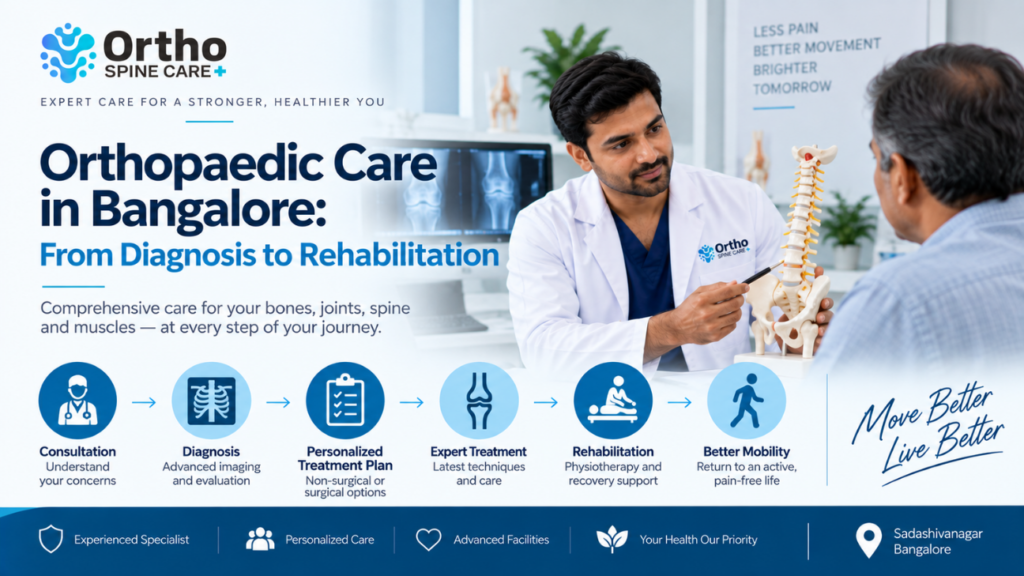
Orthopaedic Care in Bangalore: From Diagnosis to Rehabilitation
Pain in your back, knee, shoulder, hip, or other joints can affect much more than your physical comfort. A problem that starts as occasional discomfort may eventually make it difficult to walk, exercise, work, sleep, or enjoy everyday activities.
This is why orthopaedic care is not simply about treating pain. It involves understanding what is causing the problem, choosing an appropriate treatment, and helping you regain movement and function.
For people looking for orthopaedic care in Bangalore, knowing what to expect from diagnosis through rehabilitation can make the treatment journey feel much easier to understand.
What Is Orthopaedic Care?
Orthopaedic care focuses on conditions affecting the musculoskeletal system, including:
- Bones
- Joints
- Muscles
- Ligaments
- Tendons
- Spine
Orthopaedic problems can develop because of injuries, sports activities, ageing, overuse, joint degeneration, or other conditions.
Treatment is not always surgical. Depending on the diagnosis, care may involve medication, physiotherapy, rehabilitation, pain management, injections, lifestyle changes, minimally invasive procedures, or surgery when appropriate.
At OrthoSpineCare, services include spine care, fracture and trauma management, bone and joint treatment, sports injury management, pain management, physiotherapy and rehabilitation, diagnostics, and surgical care.
Step 1: Understanding Your Symptoms
The first part of good orthopaedic care is understanding what you are experiencing.
During a consultation, your doctor may ask about:
- Where you feel pain
- When the symptoms started
- Whether the pain is constant or occasional
- Whether you had an injury
- What activities make the symptoms worse
- Whether you have swelling or stiffness
- Whether your movement has become restricted
- Whether you experience numbness or tingling
- How the problem affects your daily activities
Try to describe your symptoms honestly and in your own words. You don’t need to know the medical name for your condition.
For example, instead of simply saying, “My knee hurts,” explain whether it hurts while climbing stairs, walking, sitting for long periods, or getting up from a chair.
These details can help your doctor understand the problem more clearly.
Step 2: Physical Examination
After discussing your symptoms, your orthopaedic specialist may examine the affected area.
Depending on your condition, the examination may involve checking:
- Range of motion
- Muscle strength
- Joint stability
- Swelling
- Tenderness
- Posture
- Walking pattern
- Sensation
- Other relevant physical findings
For someone with knee pain, for example, the doctor may assess how the knee moves and whether there are signs of instability or tenderness.
For back pain, the examination may focus on spinal movement, strength, sensation, and other relevant findings.
The physical examination helps provide information that cannot be obtained from symptoms alone.
Step 3: Diagnostic Tests When Needed
Not every orthopaedic problem requires imaging or other investigations.
However, depending on your symptoms and examination, your doctor may recommend tests to better understand what is happening.
These may include appropriate imaging such as:
- X-rays
- Standing X-rays
- Other imaging investigations
- Bone-density assessment when indicated
OrthoSpineCare lists digital X-rays, standing X-rays for spine and joint analysis, and bone-density/DEXA scan guidance among its diagnostic services.
The purpose of these investigations is to provide additional information that can help with diagnosis and treatment planning.
Step 4: Understanding Your Diagnosis
Once your symptoms, examination findings, and relevant investigations have been considered, your doctor can explain the likely diagnosis.
This is an important stage because the same symptom can have different causes.
For example, back pain could be associated with a muscle problem, disc condition, nerve irritation, or another spine-related issue.
Similarly, knee pain could be associated with an injury, arthritis, overuse, or another joint condition.
Understanding the underlying problem allows you and your doctor to discuss treatment options that are appropriate for your situation.
Step 5: Creating a Personalized Treatment Plan
There is no single treatment that works for every orthopaedic condition.
Your treatment plan may depend on:
- Your diagnosis
- Severity of symptoms
- Duration of the problem
- Your age and activity level
- Previous treatments
- Examination findings
- Investigation results
- Your everyday requirements
Depending on the condition, treatment may include:
Non-surgical care
- Medication
- Physiotherapy
- Exercise-based rehabilitation
- Activity modification
- Posture correction
- Pain management
- Injections
Surgical care
Surgery may be considered for selected conditions when it is appropriate based on the patient’s diagnosis and circumstances.
OrthoSpineCare provides both non-surgical and surgical treatment options across its orthopaedic and spine services.
Does Orthopaedic Treatment Always Mean Surgery?
No.
This is one of the most common concerns patients have.
Seeing an orthopaedic surgeon does not automatically mean that you will need an operation.
Many musculoskeletal problems can be managed through non-surgical approaches. Surgery may be discussed when there is a significant structural problem, persistent symptoms, certain injuries, or when other appropriate treatments have not provided sufficient improvement.
The goal is to identify an appropriate treatment for the individual condition.
Step 6: Rehabilitation and Physiotherapy
Treatment doesn’t necessarily end when pain starts improving.
For many patients, rehabilitation is an important part of returning to normal activities.
Physiotherapy may focus on:
- Improving strength
- Restoring flexibility
- Increasing joint movement
- Improving balance
- Rebuilding physical function
- Returning to normal activities
- Supporting recovery after surgery or injury
For example, after a fracture or orthopaedic procedure, the affected area may need time and structured rehabilitation to regain strength and movement.
OrthoSpineCare provides physiotherapy and rehabilitation guidance for post-injury recovery and post-surgical rehabilitation.
Step 7: Gradually Returning to Normal Activities
Recovery is not always about getting back to normal as quickly as possible.
It is about progressing safely according to your condition and treatment plan.
Depending on the problem, your healthcare team may guide you on when to gradually return to:
- Walking
- Driving
- Work
- Exercise
- Gym activities
- Sports
- Household activities
Trying to do too much too soon after an injury or procedure can interfere with recovery.
Following the rehabilitation plan and discussing your activity levels with your healthcare team can help you understand what is appropriate for your situation.
Orthopaedic Care for Common Problems
Back and Spine Problems
Back and neck problems are common reasons people seek orthopaedic care.
Conditions such as sciatica, slipped discs, spondylosis, spinal injuries, scoliosis, and other spine-related problems may require specialist evaluation.
Treatment can range from non-surgical care and rehabilitation to minimally invasive procedures or surgery for selected conditions.
Knee and Joint Problems
Knee and other joint problems can make walking, climbing stairs, exercising, or performing household activities difficult.
Treatment depends on the underlying cause and may involve medication, physiotherapy, injections, joint-preservation approaches, or joint replacement for selected severe cases.
OrthoSpineCare provides care for joints including the shoulder, elbow, wrist, hand, hip, knee, ankle, and foot.
Fractures
Fractures may require different types of treatment depending on their location and nature.
Orthopaedic fracture care can include casting, splinting, fracture reduction, fixation when required, and rehabilitation.
Sports Injuries
Sports injuries can affect athletes and people who simply enjoy staying active.
Ligament injuries, tendon problems, soft-tissue injuries, and rotator cuff problems may require specialist assessment.
Treatment can include rehabilitation and other appropriate interventions depending on the injury.
When Should You Consider Orthopaedic Care?
Consider consulting an orthopaedic specialist if you experience:
- Persistent bone or joint pain
- Recurring back or neck pain
- Difficulty walking
- Reduced joint movement
- Persistent swelling or stiffness
- Pain after an injury
- Suspected fracture
- A sports injury that isn’t improving
- Pain that travels into an arm or leg
- Numbness or tingling associated with musculoskeletal symptoms
- Pain that affects sleep or everyday activities
You don’t necessarily have to wait until the pain becomes severe.
An appropriate evaluation can help you understand what may be causing the problem and what treatment options may be suitable.
How to Prepare for Your Orthopaedic Appointment
A little preparation can make your consultation more useful.
Before your appointment, make a note of:
- When your symptoms began
- What makes them better or worse
- Previous injuries
- Previous surgeries
- Medications you take
- Treatments you have already tried
- Previous X-rays or scan reports
- How the condition affects your everyday life
You can also write down the questions you want to ask.
Some useful questions include:
What is causing my symptoms?
Do I need any tests?
What treatment options are available?
Can this condition be treated without surgery?
Will I need physiotherapy?
How long might recovery take?
When can I return to my normal activities?
Choosing Orthopaedic Care in Bangalore
If you are searching for orthopaedic care in Bangalore, consider the doctor’s qualifications, area of specialization, experience with your condition, available treatment options, and rehabilitation support.
For patients in North Bangalore, OrthoSpineCare in Sadashivanagar provides orthopaedic and spine care under Dr. Prajwal GS.
Dr. Prajwal GS’s listed qualifications include MBBS, MS Orthopaedics, fellowship training in spine surgery, minimally invasive spine surgery and orthopaedic rheumatology, along with an AO Global Spine Diploma.
The clinic provides care covering spine conditions, bone and joint problems, fractures, sports injuries, pain management, rehabilitation, diagnostic services, and surgical treatment.
Orthopaedic Care Is a Journey, Not Just a Procedure
Good orthopaedic care isn’t simply about treating the place that hurts.
It starts with understanding the problem, making an appropriate diagnosis, discussing treatment options, and helping you work toward better movement and function.
For some people, that may mean physiotherapy and rehabilitation. For others, it may involve medication, injections, a minimally invasive procedure, or surgery. The right approach depends on the individual condition.
If pain or limited mobility is affecting your work, sleep, exercise, or everyday activities, consider speaking with a qualified orthopaedic specialist.
OrthoSpineCare
No. 2, 10th Cross Road, Sadashivanagar, Bangalore – 560080
Phone: 9740559577
This article is intended for general educational purposes and does not replace an individual medical consultation. Treatment recommendations depend on the patient’s condition, examination, investigations, medical history, and clinical circumstances.