
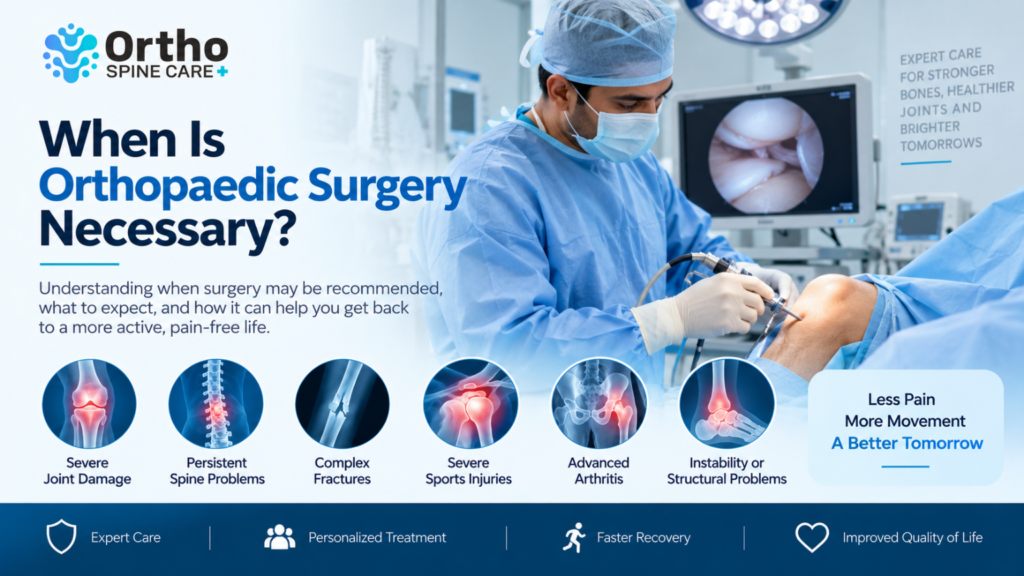
When Is Orthopaedic Surgery Necessary?
Hearing the word “surgery” can make anyone nervous. If you have persistent knee pain, a spine problem, a sports injury, or a damaged joint, you may wonder whether an operation is really necessary or whether there are other ways to manage the condition.
The good news is that orthopaedic surgery is not automatically the first treatment for every bone, joint, or spine problem. Orthopaedic care often begins with an accurate diagnosis and consideration of non-surgical treatments. Surgery may be discussed when the condition is severe, significantly affecting daily life, or when other appropriate treatments have not provided sufficient improvement.
If you are looking for an orthopaedic surgeon in Bangalore, understanding when surgery may be considered can help you have a more informed conversation with your doctor.
What Is Orthopaedic Surgery?
Orthopaedic surgery refers to procedures used to treat problems involving the musculoskeletal system, including:
- Bones
- Joints
- Spine
- Ligaments
- Tendons
- Muscles
Depending on the condition, surgery may be used to repair an injury, stabilize a fracture, relieve pressure on a nerve, replace a severely damaged joint, or address another structural problem.
The type of surgery depends entirely on the diagnosis and the patient’s individual circumstances.
Does Every Orthopaedic Problem Require Surgery?
No.
Many orthopaedic conditions can be managed without surgery.
Depending on the problem, a doctor may first consider treatments such as:
- Medication
- Physiotherapy
- Exercise and rehabilitation
- Activity modification
- Posture correction
- Pain management
- Injections
- Lifestyle changes
At OrthoSpineCare, treatment options include both non-surgical and surgical approaches for spine, bone, joint, fracture, and sports-related conditions.
The decision to operate should be based on the condition, symptoms, examination findings, investigations, and the expected benefits and risks of the procedure.
1. When a Fracture Needs Surgical Treatment
Some fractures can heal successfully with a cast, splint, or other forms of immobilization.
However, certain fractures may require surgery to restore alignment or stabilize the bone.
Factors such as the location and nature of the fracture can influence treatment.
Orthopaedic fracture care can include fracture reduction and fixation when required, alongside casting, splinting, and rehabilitation.
If you have suffered a significant injury, especially one associated with severe pain, swelling, deformity, or inability to use the affected limb, prompt medical assessment is important.
2. When Joint Damage Is Severe
Joints can become damaged because of arthritis, injuries, degeneration, or other conditions.
In the early stages, treatment may focus on controlling symptoms and maintaining movement.
However, when joint damage becomes advanced and significantly affects mobility and everyday activities, surgical options may be considered.
For selected patients, joint replacement can be an option for severely damaged joints. OrthoSpineCare’s listed surgical services include knee, hip, and shoulder replacement procedures.
A joint replacement decision should be made after an individual assessment rather than based on pain alone.
3. When Persistent Pain Is Affecting Your Daily Life
Pain can become more than an occasional inconvenience.
If persistent pain makes it difficult to:
- Walk
- Climb stairs
- Work
- Exercise
- Sleep
- Perform household activities
- Participate in hobbies
- Carry out normal daily tasks
it may be time for a specialist evaluation.
This does not necessarily mean surgery is required. Instead, it means the underlying problem should be assessed and all appropriate treatment options considered.
If non-surgical approaches have been tried appropriately and symptoms continue to significantly affect your quality of life, surgery may sometimes become part of the discussion.
4. When a Spine Problem Requires Surgical Intervention
Many back and neck problems can be managed without surgery.
However, certain spinal conditions may require surgical treatment when there is a significant structural problem or when symptoms and clinical findings indicate that an operation may provide meaningful benefit.
Conditions that may sometimes require surgical evaluation include:
- Certain slipped disc or disc prolapse cases
- Some forms of spinal stenosis
- Certain spinal injuries
- Some spinal deformities
- Selected cases of persistent nerve compression
OrthoSpineCare lists minimally invasive, endoscopic, and open spine procedures among its surgical services.
The decision depends on the individual diagnosis and assessment.
5. When a Nerve Is Being Compressed
Some spine conditions can irritate or compress nerves.
This can result in symptoms such as:
- Shooting pain
- Numbness
- Tingling
- Weakness
- Pain extending into an arm or leg
Not every case requires surgery. Depending on the condition, non-surgical treatment may be considered first.
However, persistent or significant nerve-related symptoms may require specialist evaluation to determine whether a surgical procedure is appropriate.
New or severe neurological symptoms should receive prompt medical attention.
6. When a Sports Injury Damages a Ligament or Joint
Sports injuries can range from minor strains to significant ligament and joint injuries.
Some injuries respond well to rest and rehabilitation. Others may result in instability or structural damage that requires surgical consideration.
For example, certain ligament injuries or rotator cuff injuries may require specialist assessment to determine whether surgery is appropriate.
OrthoSpineCare provides sports injury management for ligament and soft-tissue injuries, tendonitis, and rotator cuff injuries, along with arthroscopy for selected ligament and joint injuries.
The treatment decision depends on the specific injury, its severity, activity requirements, and other individual factors.
7. When Non-Surgical Treatment Has Not Provided Enough Improvement
Doctors often consider conservative treatment before recommending surgery when it is clinically appropriate.
This may include:
- Physiotherapy
- Rehabilitation
- Medication
- Activity modification
- Pain management
- Injections
If symptoms continue despite appropriate treatment, your doctor may reassess the diagnosis and discuss other options.
Surgery should not be viewed simply as the next step because a certain number of weeks have passed. The decision should be based on whether the expected benefits of surgery outweigh its risks for the individual patient.
8. When the Condition Is Getting Worse
Some musculoskeletal problems gradually progress.
If pain, stiffness, weakness, instability, or loss of mobility is getting worse, it may be important to have the condition reassessed.
Early specialist evaluation does not necessarily mean you will need surgery. It can help establish what is happening and whether there are treatment options that could prevent further deterioration or improve function.
Surgery Should Be a Considered Decision
Choosing surgery is an important decision, and patients should understand why it is being recommended.
Before agreeing to a procedure, consider asking your orthopaedic surgeon:
About the diagnosis
- What exactly is causing my symptoms?
- What did the examination or imaging show?
- How severe is the condition?
About treatment
- What non-surgical options are available?
- Have we tried appropriate conservative treatment?
- What happens if I don’t have surgery now?
About the procedure
- What does the surgery involve?
- What are the potential benefits?
- What are the possible risks?
- How long could recovery take?
- Will I need physiotherapy afterward?
- When could I return to normal activities?
A clear conversation can help you understand your options and make decisions based on your individual situation.
What Happens Before Orthopaedic Surgery?
If surgery is being considered, your doctor will generally review your symptoms, medical history, examination findings, and relevant investigations.
Depending on the procedure and your circumstances, additional medical evaluation may be required before surgery.
Your surgeon should also explain the procedure and recovery process so that you understand what to expect.
Preparation can be different for every operation, so follow the specific instructions provided by your healthcare team.
What Happens After Surgery?
Surgery is only one part of the treatment journey.
Recovery may involve:
- Pain management
- Wound care
- Activity restrictions
- Physiotherapy
- Strengthening exercises
- Gradual return to normal activities
- Follow-up appointments
The recovery period varies depending on the type of surgery and the individual patient.
Rehabilitation can be particularly important following orthopaedic procedures because restoring movement and strength may take time.
OrthoSpineCare includes post-surgical rehabilitation guidance among its services.
Minimally Invasive Orthopaedic Surgery
Advances in orthopaedic treatment have led to minimally invasive approaches for selected conditions.
These procedures generally aim to reduce disruption to surrounding tissues compared with certain traditional surgical approaches.
However, minimally invasive does not mean risk-free or appropriate for everyone.
The right procedure depends on the patient’s condition, anatomy, diagnosis, and the surgeon’s assessment.
OrthoSpineCare lists minimally invasive and endoscopic spine procedures among its services.
How Do You Know If Surgery Is Right for You?
There is no single symptom that automatically means you need orthopaedic surgery.
A doctor may consider several factors, including:
- Your diagnosis
- Severity of the condition
- Duration of symptoms
- Effect on daily activities
- Examination findings
- Imaging or other investigations when appropriate
- Response to non-surgical treatment
- Potential benefits of surgery
- Potential risks of surgery
- Your individual goals and circumstances
Two people with the same diagnosis may not necessarily require the same treatment.
That is why an individual consultation is important.
Choosing an Orthopaedic Surgeon in Bangalore
If you have been advised to consider surgery, choosing a qualified specialist and having a detailed discussion about your treatment options is important.
For patients in North Bangalore, OrthoSpineCare in Sadashivanagar provides orthopaedic and spine care under Dr. Prajwal GS.
Dr. Prajwal GS is an Orthopaedic and Spine Surgeon with listed qualifications including MBBS, MS Orthopaedics, fellowship training in spine surgery, minimally invasive spine surgery and orthopaedic rheumatology, as well as an AO Global Spine Diploma.
The clinic provides surgical and non-surgical care for spine conditions, fractures, joint problems, sports injuries, and other orthopaedic conditions.
Don’t Rush Into Surgery—Understand Your Options
Orthopaedic surgery can be an important treatment option for certain conditions, but it is not automatically necessary whenever you experience bone or joint pain.
The first step is understanding what is causing your symptoms.
In many situations, non-surgical treatment may be appropriate. In others, surgery may provide a suitable solution when a structural problem is severe, symptoms are persistent, or other appropriate treatments have not been effective.
If you are experiencing ongoing pain, difficulty moving, a significant injury, or spine-related symptoms, consult a qualified orthopaedic specialist for an individual assessment.
OrthoSpineCare
No. 2, 10th Cross Road, Sadashivanagar, Bangalore – 560080
Phone: 9740559577
This article is intended for general educational purposes and does not replace an individual medical consultation. Whether surgery is appropriate depends on the patient’s diagnosis, examination, investigations, medical history, and clinical circumstances.