
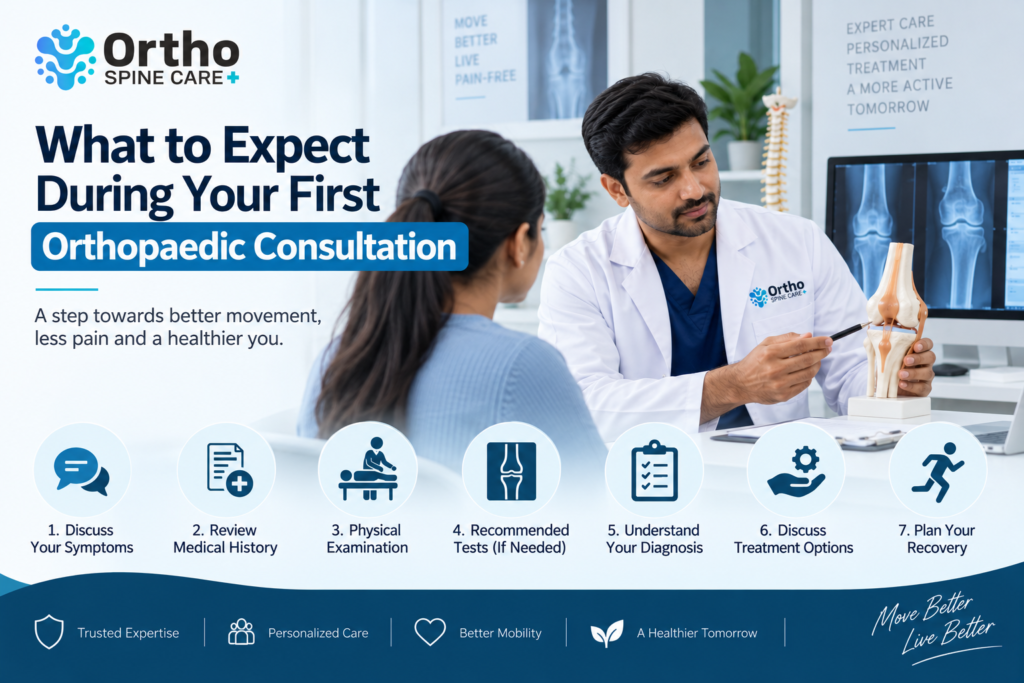
What to Expect During Your First Orthopaedic Consultation
Visiting an orthopaedic surgeon for the first time can feel a little uncertain. You may be wondering what questions the doctor will ask, whether you need an X-ray or scan, or whether your pain could eventually require surgery.
The good news is that your first orthopaedic consultation is mainly about understanding your symptoms, identifying the possible cause, and discussing appropriate treatment options. It does not automatically mean that you will need surgery.
Whether you are dealing with knee pain, back pain, a sports injury, a fracture, shoulder discomfort, or another bone and joint problem, knowing what to expect can make your appointment more comfortable.
If you are looking for an orthopaedic surgeon in Bangalore, here is a simple guide to what usually happens during your first consultation.
Why Is an Orthopaedic Consultation Important?
Pain in your bones, joints, muscles, or spine can have many possible causes. Two people may have similar symptoms but require completely different treatments.
For example, knee pain could be related to an injury, arthritis, overuse, or another joint problem. Similarly, back pain may be associated with posture, muscle problems, a disc condition, or a spine-related issue.
An orthopaedic consultation helps the doctor understand your symptoms and assess the affected area before recommending a treatment approach.
At OrthoSpineCare, orthopaedic and spine care includes conditions involving the spine, joints, bones, fractures, sports injuries, and other musculoskeletal problems.
1. Your Doctor Will Ask About Your Symptoms
The consultation usually begins with a conversation about what you are experiencing.
Your doctor may want to know:
- Where exactly do you feel the pain?
- When did it begin?
- Did it start suddenly or gradually?
- Did you have an injury or accident?
- Is the pain constant or does it come and go?
- What activities make it worse?
- Does rest make it better?
- Does the pain affect your sleep?
- Do you have stiffness or swelling?
- Do you experience numbness or tingling?
- Has the pain affected your ability to walk or move?
Try to describe your symptoms as clearly as possible.
You don’t need to know the medical terminology. Simply explain what you feel and how the problem affects your daily life.
2. Your Medical History May Be Discussed
Your previous health history can provide useful information when evaluating an orthopaedic problem.
Your doctor may ask about:
- Previous injuries
- Previous surgeries
- Existing medical conditions
- Medications you are taking
- Previous treatments
- Earlier X-rays, scans, or medical reports
- Previous episodes of similar pain
If you have visited another doctor or undergone imaging for the same problem, bring those reports if they are available.
Having previous records can help provide a clearer picture of your condition.
3. The Doctor Will Examine the Affected Area
After discussing your symptoms, the doctor may perform a physical examination.
Depending on your complaint, this could involve checking:
- Joint movement
- Muscle strength
- Swelling
- Tenderness
- Stability
- Range of motion
- Posture
- Walking pattern
- Sensation or nerve-related signs
For example, if you have knee pain, the doctor may examine how your knee moves and assess areas of tenderness or instability.
If you have back pain, the examination may focus on your spine, movement, strength, sensation, and other relevant findings.
The examination helps the doctor understand your symptoms beyond what can be learned from conversation alone.
4. You May Be Recommended Diagnostic Tests
Not every patient needs an X-ray or scan.
If your symptoms and physical examination indicate that imaging or another investigation would be useful, your doctor may recommend an appropriate test.
Depending on the condition, diagnostic evaluation may involve imaging such as:
- Digital X-rays
- Standing X-rays
- Other appropriate imaging investigations
- Bone density assessment when indicated
OrthoSpineCare lists digital X-ray services, standing X-rays for spine and joint analysis, and bone-density/DEXA scan guidance among its diagnostic services.
The purpose of diagnostic testing is to provide additional information that can help with diagnosis and treatment planning.
5. Your Doctor Will Explain the Possible Diagnosis
Once your symptoms, examination findings, and relevant investigations have been considered, your doctor can explain what may be causing your problem.
This is a good time to ask questions.
If you don’t understand a medical term, ask the doctor to explain it in simpler language.
You can ask:
“What is causing my pain?”
“Is this condition serious?”
“Will it get worse if I leave it untreated?”
“What treatment options do I have?”
Understanding your condition can make it easier to participate in decisions about your care.
6. Treatment May Not Involve Surgery
One of the biggest concerns patients have before visiting an orthopaedic surgeon is the possibility of surgery.
However, an orthopaedic consultation does not automatically lead to an operation.
Depending on the condition, treatment may include:
- Medication
- Activity modification
- Physiotherapy
- Rehabilitation
- Posture correction
- Pain management
- Injections
- Lifestyle changes
- Minimally invasive procedures
- Surgery when appropriate
The treatment approach depends on the diagnosis and individual circumstances.
OrthoSpineCare specifically provides both surgical and non-surgical orthopaedic and spine treatment options.
7. You May Be Given a Physiotherapy or Rehabilitation Plan
For many musculoskeletal problems, rehabilitation is an important part of recovery.
If appropriate, your treatment plan may include physiotherapy or exercises designed to improve:
- Strength
- Flexibility
- Movement
- Balance
- Joint function
- Recovery after an injury or procedure
Rehabilitation may also be recommended following surgery or fracture treatment.
OrthoSpineCare provides physiotherapy and rehabilitation guidance for post-injury recovery and post-surgical rehabilitation.
8. Your Doctor May Discuss Different Treatment Options
Sometimes there is more than one possible way to manage a condition.
Your doctor may explain the available options and discuss their potential benefits, limitations, and expected recovery.
For example, depending on the condition, treatment could involve conservative management first, while certain cases may require a procedure or surgery.
Don’t hesitate to ask:
- Why are you recommending this treatment?
- Are there non-surgical options?
- How long might recovery take?
- What should I avoid during recovery?
- Will I need physiotherapy?
- What happens if the treatment doesn’t improve my symptoms?
A consultation should give you an opportunity to understand your options.
9. You Can Ask Questions
You don’t need to wait for the doctor to finish before asking questions.
In fact, writing down your questions before your appointment can be helpful.
Here are some useful questions to consider:
About your condition
- What is causing my symptoms?
- What tests do I need?
- Is my condition temporary or long-term?
- What symptoms should I watch for?
About treatment
- What treatment do you recommend?
- Can this be treated without surgery?
- Will I need physiotherapy?
- How long could recovery take?
- Can I continue my normal activities?
About surgery, if recommended
- Why is surgery being considered?
- What are the alternatives?
- What does the procedure involve?
- What will recovery involve?
- When can I return to normal activities?
Having these questions ready can help you make better use of your consultation.
10. Bring Your Previous Medical Reports
If you have already undergone tests or received treatment elsewhere, bring your relevant medical documents.
These may include:
- X-ray reports
- MRI reports
- CT scan reports
- Blood test reports relevant to your condition
- Previous prescriptions
- Surgical records
- Physiotherapy records
You don’t necessarily need to repeat investigations if your doctor already has useful recent information, although the doctor will decide whether additional testing is appropriate.
How Long Does an Orthopaedic Consultation Take?
The duration can vary depending on the reason for your visit and the complexity of your symptoms.
A straightforward consultation may be relatively quick, while a more complicated condition may require a detailed discussion, examination, and review of previous reports or investigations.
Rather than focusing on the exact number of minutes, the important thing is that you have enough opportunity to explain your symptoms and understand the recommended next steps.
What Should You Wear to Your Appointment?
Wear comfortable clothing that allows the affected area to be examined easily.
For example, if you are visiting because of knee or leg pain, clothing that allows the doctor to examine the knee and surrounding area can be helpful.
Similarly, for shoulder, neck, or spine problems, comfortable clothing can make the physical examination easier.
If you are unsure, simply choose comfortable everyday clothing.
What If You Are Nervous About Your First Appointment?
It is completely normal to feel nervous when visiting a specialist.
You don’t need to prepare a medical presentation or know exactly what is wrong.
Simply explain:
What hurts → when it started → what makes it worse → what you have already tried → how it affects your daily life.
Your doctor will guide the rest of the conversation.
If someone in your family helps you remember medical information or previous treatments, you may also consider bringing them with you.
When Should You Consider an Orthopaedic Consultation?
You may want to consider seeing an orthopaedic specialist if you experience:
- Persistent joint pain
- Recurring back or neck pain
- Difficulty walking
- Reduced joint movement
- Persistent swelling or stiffness
- Pain after an injury
- Suspected fracture
- Sports injuries that aren’t improving
- Pain that travels into an arm or leg
- Numbness or tingling associated with musculoskeletal symptoms
- Pain that interferes with sleep or everyday activities
You don’t necessarily have to wait until pain becomes severe.
Getting an appropriate evaluation can help you understand what may be causing the problem and what treatment options may be available.
Your First Consultation Is the Start of Understanding the Problem
Visiting an orthopaedic surgeon for the first time doesn’t have to be intimidating.
The appointment is primarily about listening to your concerns, examining the problem, understanding the possible cause, and creating an appropriate treatment plan.
Whether you have knee pain, back pain, a sports injury, a fracture, or another musculoskeletal concern, asking questions and understanding your treatment options can help you feel more confident about the next step.
For patients looking for an orthopaedic surgeon in Bangalore, OrthoSpineCare is located in Sadashivanagar and provides orthopaedic and spine care under Dr. Prajwal GS. The clinic’s services include fracture management, spine care, bone and joint treatment, sports injury management, pain management, rehabilitation, diagnostic services, and surgical care.
Dr. Prajwal GS’s listed qualifications include MBBS, MS Orthopaedics, fellowship training in spine surgery, minimally invasive spine surgery and orthopaedic rheumatology, along with an AO Global Spine Diploma.
Take the First Step Toward Better Mobility
Pain doesn’t always have a simple explanation, and trying to manage recurring symptoms on your own may not address the underlying problem.
If pain, stiffness, injury, or reduced mobility is affecting your everyday life, an orthopaedic consultation can be a useful first step toward understanding what is happening.
OrthoSpineCare
No. 2, 10th Cross Road, Sadashivanagar, Bangalore – 560080
Phone: 9740559577
This article is intended for general educational purposes and does not replace an individual medical consultation. Treatment recommendations depend on the patient’s condition and clinical assessment.