
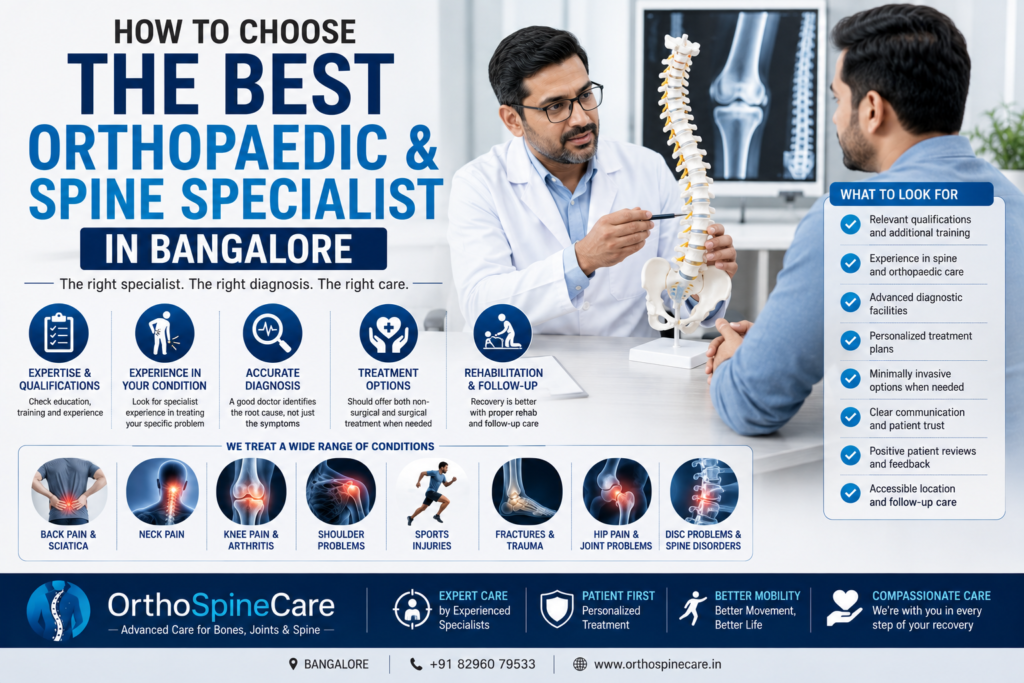
How to Find the Right Orthopaedic Specialist in Bangalore
When knee pain makes climbing stairs difficult, back pain starts affecting your workday, or a sports injury keeps you away from the activities you enjoy, finding the right orthopaedic specialist becomes an important decision.
Bangalore has no shortage of hospitals, clinics, and orthopaedic doctors. But having many choices can make the decision harder—not easier.
Should you choose a specialist based on experience? Location? The treatment options they offer? Patient reviews? Or whether they recommend surgery?
The answer is that there isn’t one factor that makes an orthopaedic specialist right for everyone. Your choice should depend on your condition, treatment needs, and how comfortable you feel with the doctor’s approach.
Here are some practical things to consider when looking for the right orthopaedic specialist in Bangalore.
What Does an Orthopaedic Specialist Treat?
Orthopaedic specialists diagnose and manage conditions affecting the musculoskeletal system, including bones, joints, muscles, ligaments, tendons, and the spine.
Patients may consult an orthopaedic specialist for problems such as:
- Knee pain
- Hip pain
- Shoulder pain
- Arthritis
- Sports injuries
- Ligament and tendon injuries
- Fractures
- Back and neck problems
- Joint stiffness
- Musculoskeletal injuries
- Spine-related conditions
Because orthopaedics is a broad field, different doctors may have particular areas of expertise. This is one of the first things you should consider.
1. Look for Expertise Relevant to Your Problem
One of the most important factors is whether the doctor’s experience matches your condition.
For example, if you’re experiencing persistent back pain with leg symptoms, you may want to consult someone with experience in spine care. If you’re recovering from a sports injury, a specialist experienced in sports-related musculoskeletal problems may be more appropriate.
Before booking an appointment, check:
- The doctor’s qualifications
- Areas of specialization
- Clinical experience
- Types of conditions treated
- Relevant training and fellowships
You don’t necessarily need the doctor with the longest list of qualifications. What matters is whether their expertise is relevant to your particular problem.
2. Don’t Choose a Doctor Based Only on Online Ratings
Online reviews can be useful, but they shouldn’t be the only reason you choose a doctor.
A review may tell you about someone’s experience with communication, waiting time, or the overall clinic environment. However, one patient’s experience doesn’t necessarily tell you whether a particular treatment is appropriate for your condition.
Instead, consider reviews alongside:
- Professional qualifications
- Relevant experience
- Treatment approach
- Clinic facilities
- Communication style
- Your individual medical needs
Think of reviews as one piece of the puzzle, rather than the entire decision.
3. Pay Attention to the Diagnosis
A good orthopaedic consultation should begin with understanding your problem.
The doctor may ask about:
- When your symptoms started
- Previous injuries
- Your medical history
- Activities that worsen the pain
- Previous treatments
- Your physical activity
- Any associated symptoms
A physical examination may then help the doctor understand the problem more clearly.
Depending on the situation, diagnostic tests such as X-rays, MRI scans, CT scans, or other investigations may be recommended.
The goal is to identify the underlying cause rather than simply treat the location where you feel pain.
4. Ask About Your Treatment Options
Once you understand the diagnosis, ask what treatment options are available.
Depending on the condition, orthopaedic treatment may include:
- Activity modification
- Physiotherapy
- Exercise and rehabilitation
- Medications
- Lifestyle changes
- Injections in selected cases
- Bracing or supportive devices
- Minimally invasive procedures
- Surgery when appropriate
A good consultation should give you an understanding of why a particular treatment is being recommended.
5. Don’t Assume Surgery Is Always Necessary
The word “orthopaedic” sometimes makes people immediately think about surgery.
But that’s not how modern orthopaedic care works.
Many conditions can be managed initially with non-surgical treatment when clinically appropriate. Physiotherapy, strengthening exercises, activity modification, medications, and other approaches may be considered depending on the diagnosis.
Surgery may become an option when there is a significant structural problem or when appropriate non-surgical treatments have not provided enough improvement.
If surgery is recommended, don’t be afraid to ask:
- Why is surgery being considered?
- Are there appropriate alternatives?
- What happens if I wait?
- What does recovery involve?
- What are the potential risks and benefits?
Understanding the reasoning behind a recommendation can help you make a more informed decision.
6. Consider the Doctor’s Communication Style
Medical treatment isn’t just about tests and procedures. Communication matters too.
You should feel comfortable asking questions about your condition and treatment.
During your consultation, notice whether the doctor:
- Listens carefully to your concerns
- Explains the diagnosis clearly
- Answers your questions
- Discusses treatment choices
- Explains potential risks and benefits
- Gives realistic expectations about recovery
You don’t need to understand every medical term. A good specialist should be willing to explain things in language you can understand.
7. Look at the Complete Treatment Journey
Orthopaedic care doesn’t always end when the initial pain improves.
For many conditions, recovery may involve rehabilitation and gradual return to normal activities.
Depending on your problem, ask about:
- Physiotherapy
- Rehabilitation
- Follow-up appointments
- Exercise guidance
- Return-to-work recommendations
- Return-to-sport planning
This can be particularly important after injuries or procedures.
8. Consider Convenience—But Don’t Make It the Only Factor
Bangalore is a large city, and travelling across the city for repeated appointments can become difficult.
Location and accessibility are therefore worth considering, particularly if you require multiple follow-up visits or physiotherapy sessions.
However, convenience shouldn’t completely outweigh medical expertise.
Ideally, look for a specialist who offers the appropriate expertise while remaining reasonably accessible for you.
9. Ask Questions During Your First Consultation
You don’t have to walk into your appointment knowing exactly what to ask.
A few simple questions can make the consultation more useful:
“What is causing my pain?”
“Do I need any tests?”
“What treatment options do I have?”
“Can this condition be managed without surgery?”
“How long might recovery take?”
“What activities should I avoid?”
“Will I need physiotherapy?”
These questions can help you understand both the problem and the treatment plan.
10. Be Careful About Guaranteed Results
Be cautious if someone promises a guaranteed cure or a specific result without properly evaluating your condition.
Orthopaedic problems vary significantly from one patient to another. Recovery depends on factors such as the underlying condition, severity, age, general health, treatment response, and adherence to rehabilitation.
A responsible specialist should explain what can reasonably be expected rather than making unrealistic promises.
When Should You See an Orthopaedic Specialist?
You may want to consider an orthopaedic consultation if you have:
- Persistent joint pain
- Repeated back pain
- Difficulty walking
- Joint swelling or stiffness
- Reduced range of motion
- Pain after an injury
- Repeated sports injuries
- Persistent shoulder or knee pain
- Numbness, tingling, or weakness associated with spine symptoms
- Pain that interferes with work, sleep, exercise, or everyday activities
You should seek prompt medical attention after a significant injury if there is severe pain, obvious deformity, inability to use the affected limb, or other concerning symptoms.
Why Bangalore Patients Should Consider Specialized Orthopaedic Care
Bangalore’s active lifestyle and demanding work environment mean people may experience musculoskeletal problems for very different reasons.
An office worker may struggle with persistent neck or back discomfort. A recreational runner may develop a knee problem. An older adult may experience arthritis-related stiffness. Someone else may need treatment following an accident.
The important point is that the same symptom can have different causes.
That is why choosing a specialist based on your specific problem can be more useful than simply searching for a doctor with a generic “orthopaedic” label.
Orthopaedic Care at OrthoSpineCare
At OrthoSpineCare, orthopaedic and spine care is provided based on the patient’s symptoms, diagnosis, and individual treatment requirements.
The practice is led by Dr. Prajwal G S, an orthopaedic and spine surgeon. Care may involve evaluation and management of spine conditions, joint problems, fractures, sports injuries, and other musculoskeletal concerns.
Depending on the diagnosis, treatment can include non-surgical approaches, rehabilitation, minimally invasive procedures, or surgery when appropriate.
For patients searching for an orthopaedic specialist in Bangalore, discussing your symptoms with a qualified specialist can help you understand the cause of your problem and the treatment options available.
OrthoSpineCare Appointment Number: 9740559577
Frequently Asked Questions
How do I choose the best orthopaedic specialist in Bangalore?
Start by looking at the doctor’s qualifications, experience, relevant area of expertise, treatment approach, communication style, and rehabilitation support. Your choice should be based on how well the specialist’s expertise matches your condition.
Should I see an orthopaedic doctor for knee pain?
If knee pain is persistent, recurring, worsening, or affecting your normal activities, an orthopaedic evaluation can help identify the cause and determine appropriate treatment.
Does seeing an orthopaedic specialist always mean surgery?
No. Many orthopaedic conditions can be treated without surgery. The appropriate treatment depends on the diagnosis and individual circumstances.
What should I take to my first orthopaedic appointment?
Bring previous medical records, relevant scan or X-ray reports, a list of current medications, and information about previous treatments or injuries. A short note describing when your symptoms started can also be helpful.
How quickly should I see an orthopaedic specialist after an injury?
It depends on the severity of the injury. Severe pain, deformity, significant swelling, inability to bear weight or use the affected body part, or neurological symptoms should receive prompt medical evaluation.
Conclusion
Finding the right orthopaedic specialist in Bangalore isn’t simply about choosing the doctor with the highest rating or the longest list of qualifications.
It’s about finding someone whose expertise matches your condition, who takes time to understand the problem, explains your options clearly, and develops a treatment plan based on your individual needs.
Whether you’re dealing with knee pain, arthritis, a sports injury, back pain, or another orthopaedic problem, don’t hesitate to ask questions and understand your treatment choices.
Most importantly, don’t wait until pain begins controlling your daily life. A timely evaluation can help you understand what’s causing the problem and what steps you can take toward better movement and recovery.